
Three Years of Trends: What British Players Gamble On

The other day, the United Kingdom Gambling Commission (UKGC) published an annual report with findings on participation from the Gambling Survey for Great Britain (GSGB). It covers the overall rates and explores the dominant activities and motivations for gambling. With this survey, the officials can now compare year-on-year trends and assess how harms evolve.
Key Takeaways
- 2.4% of respondents have a Problem Gambling Severity Index (PGSI) of 8 and over.
- 59% of 20,680 participants were involved in any kind of gambling over the past year.
- The online gaming rate is 38%, while only 28% of British adults gamble in person.
- 84% of respondents gambled for a chance to win big money, and 54% pursued entertainment purposes.
- Lotteries remain the headline activity at a 36% rate, while casino games and slot machines fall under the 5% threshold.
- 2.7% of respondents faced one or several severe consequences, while only 3.3% contacted support services.
The Essence of the GSGB Report
This is the annual research GSGB conducts to get a slice of valuable data on gaming participation in the country. It aims to answer the following questions:
- Who is involved in gambling?
- Why do individuals keep taking part in such activities?
- What types of activities prevail in the UK community?
- How strong are the consequences for gamblers and affected others?
With this data, the UKGC completes a three-year cycle and thus reaches a substantial milestone. The information is available for three consecutive years. This makes it possible to detect patterns and track changes over time.
A Quick Look at Methodology
The GSGB engaged 17,713 residents of England aged 18+ years old. What makes this survey special is its push-to-web approach. They first contacted the selected households by mail and asked them to complete the questionnaire online (67%). Those who don’t respond get the physical survey by post (33%).
British Gaming Trends from 2023 to 2025
Overall rates remained stable. The 2025 data shows that 59% of people gambled over the last year. The active participation rate excluding lotteries is 40%. We see just a 1% drop in rates compared to 2024, but it’s necessary to consider a1,000-person gap in the number of respondents. The survey reveals a slight drop in active participation across the 18-24 and 25-34 age groups, which can only be rejoiced.
But we also noticed a 1% growth in gambling among respondents over 55. Older generations may now feel more comfortable going online, as many licensed online casinos become more intuitive and mobile-friendly.
Lotteries and Scratch Cards Dominate
The gambling activity, generally perceived as casino gaming, looks a bit different in the UK. As the survey reveals, 36% of respondents are more interested in lotteries than casino games (3%), slot machines (5%), etc. Scratch cards are the runner-ups, featuring a 12% participation. The data from 2024 and 2023 show nearly the same percentage ratio, although fewer respondents were involved.
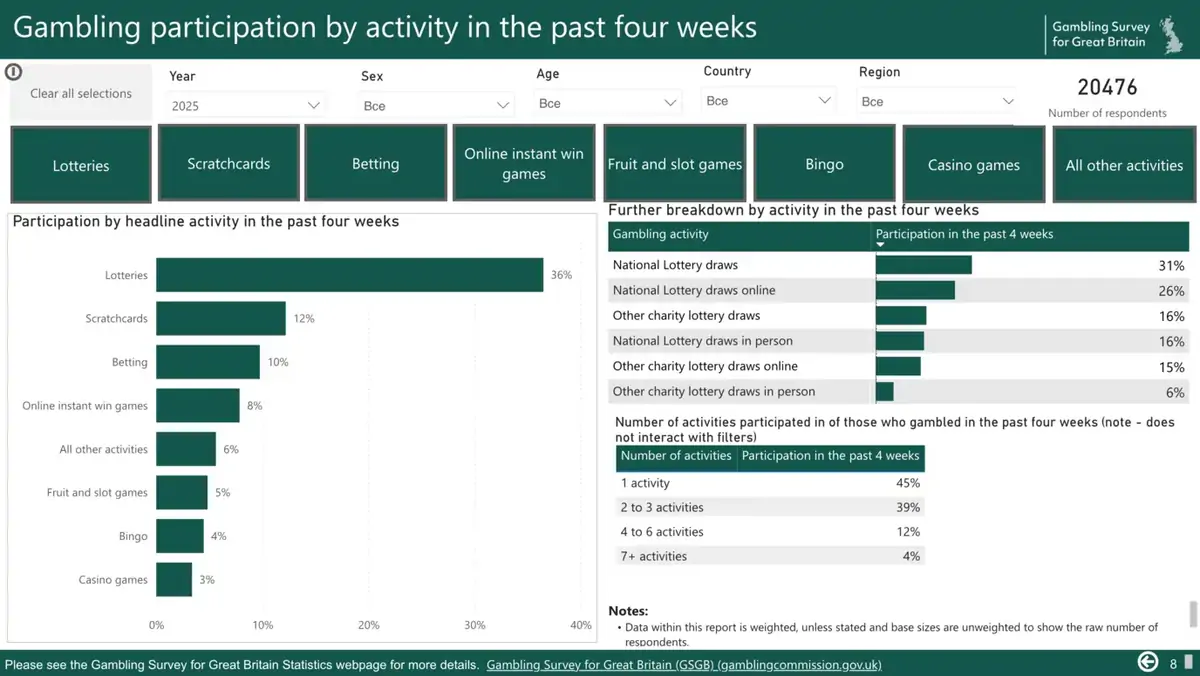
Betting took 10% of the share in 2025. But we can expect this value to grow this year, given that many Britons have a passion for football. Thus, they are likely involved in the World Cup action. However, we have to wait for the next report to see the actual numbers.
It’s nice to see that Brits spend their free time doing a variety of lifestyle activities. The report says people hang out with friends and family, listen to music, go to the cinema, do sports, etc. With 94% of adults watching TV, it’s clear why industry officials such as the All-Party Parliamentary Group on Gambling Reform (APPG) and Peers for Gambling Reform (PGR) call for a crackdown on gambling ads.
What Makes People Gamble
As follows from the chart, financial and entertainment purposes remain the key drivers for UK punters. And the numbers prove it:
- 37% of people always start gaming for a chance to win big money, while 33% sometimes pursue that goal.
- For 14% of participants, this activity is always a way to have fun. 38% of respondents agree with it sometimes.
- Among the 11,343 respondents, 21% always focus on making money, and only 25% think of it sometimes.
In total, over 80% of punters treat this activity as a chance to win money, and 57% intentionally start it to increase earnings. Overall, 53% of respondents treat it as a form of day-to-day entertainment.
The Support Usage in Numbers
Among the 8678 respondents, only 3.3% tried to access any kind of assistance:
- gambling support services;
- mental health assistance;
- counselling services.
The 2025 rate aligns with the previous years. It may suggest that gaming activity doesn’t have any negative effects on participants. Or, the affected individuals have some kind of block preventing them from asking for guidance.
The number of British residents who scored 8+ on the Problem Gambling Severity Index (PGSI) is 2.4%. It’s just 0.3% less than in 2024. The negative consequences of gambling still persist, so the industry needs to develop new ways of tackling them.
Criticism of the GSGB & UKGC Report
The industry analysts cast doubt upon the numbers in the survey. There’s talk that the Gambling Commission published inaccurate and inflated data on gaming participation. The core criticism revolves around the flawed methodology affected by bias, over-sampling of punters, and the lack of analytical transparency.
While the truth is yet to come with additional reports from the GSGB, this survey remains a valuable source of insights into gambling behaviours. It doesn’t show a substantial dip in participation and involvement rates, thus requiring changes to gaming-related policies and regulations.







Please, login or register.