Poker Rules for Beginners - How to Play Poker













Here’s a simple guide on how to play poker, a one-stop hub for enthusiasts. With it, you’ll quickly learn all poker basics: player actions, the sequence of betting rounds up to showdown, winner determination, etc. We’ll break down distinct points in different variations: forced bets, high & low ranking systems. Plus, you’ll also learn how rules deviate in tournaments and cash games and which format is a better fit for you.
What is Poker?
Poker is the general term for a group of competitive card games in which punters gamble on which hand wins according to the specific ruleset. Player quantity, actions and deck size stay consistent in most cases, except for the short pack variation. The major points of difference are the cards in play: their number, how they are dealt (face up or face down) and whether players share them.
Poker for beginners, intermediate and advanced players differs, and skipping the fundamentals will result in quick losses.
Cardmates is a structured hub and a safe place to learn the basics of poker. As you visit our online poker school, you’ll find a wealth of educational content for newcomers written by expert editors.
Poker Basics: Where to Begin?
Below, we’ve put real playing fundamentals to hopefully make the learning path clearer for beginners.
Important starting concepts:
- Poker hand rankings. Knowledge of which combinations are stronger/weaker directly shows whether you are ahead or behind opponents when the river arrives. Knowing how to form each will help you navigate through your hole cards and those on the board quickly and with more confidence.
- Basic poker rules. You cannot play without knowing the goal, possible structures, player actions, forced wagers, deal sequence, etc. We explain everything on this page by covering both what's common across most game types and highlighting the key differences.
- Poker terminology. Any game has its own slang language, and by visiting our dedicated section, you get poker explained through lingo. Learning specific terms will help you understand content on this page, as well as theory articles, table talks, strategy guides and tutorial videos without getting lost.
- Poker starting hands. Not all cards are profitable to continue to the flop, and by learning ranges, your preflop hand selection will be much smarter. When you know which starters win more frequently and which lose, you earn money, not waste it.
- Popular types of poker games. Once you learn the classic format, it’s worth checking out other variations to expose yourself to new experiences and settle on your preferred one. Plus, less popular disciplines have lower competition, so it’s easier to be on top there.
Basics of poker are the skeleton, and we do not recommend that you move any further without familiarising yourself with the core concepts. Do not skip studying theory, especially hand rankings.
Basic Rules of Poker Across Most Games
Take any poker variant in the online and offline markets, they aim for the same thing: to win the hand. How to achieve this? There are two ways to grab the pot:
- Force all your rivals to muck what they hold before the reveal stage.
- Beat your opponents during the showdown by building the strongest combo.
Regardless of whether you're addressing it for recreational purposes or as a serious pursuit, ground poker game rules remain consistent.
Let’s have a look at the common traits. Exploring them, you’ll be able to transfer skills and get the flow of new variants faster.
Betting Actions
Decision options are among the primary aspects that unite community card games and those with private cards. The most similarities are gathered in Texas Holdem rules, and player moves take central stage in this regard.
On each street, punters have such options for their moves:
- Bet – when one invests chips in the pot.
- Raise – increase of the existing bet by adding more chips compared to the punter acting before your turn.
- Reraise, 3-bet – raising after somebody else has already boosted the bet during the ongoing round.
- Call – fitting your rival’s bet or raise by putting an equal number of chips on the line.
- Check – passing the turn to your opponent. This action implies that you continue playing but do not add any chips to the pot. Checking is available in the following situations:
- on preflop – when playing from the big blind (BB), provided that nobody raised before you;
- on post-flop – your word is first, or when someone already checked before you.
- Check-raise – this is a more advanced tactic where you first skip your turn (that is, play check) and then raise your rival’s bet.
- All In (shove, jam, push) – putting all of your chips (entire stack) on the line.
- Fold – when one refuses their further hunt for the pot, mucking the starting hand.
Speaking about the fold, it is where the next level of understanding of how to play poker for beginners lies. Folding must be timely so that you do not waste a portion of the stack on a losing holding.
Main Structures of Betting
Rules of poker employ multiple systems that control the size of allowed wagers. See the three categories:
- No limit – enables participants to bet as much as their stack size (a very demanded choice).
- Pot limit – size of the pot dictates the max bet amount (wagers escalate as the pot grows).
- Fixed limit – the set bet cap cannot be exceeded. Typically, raises per street are also restricted. This helps protect players’ bankrolls as they do not risk losing their entire stack all at once.
Now that you know the simple poker rules that govern actions and bet size restrictions, let’s proceed to the rounds of placing bets.
Betting Rounds in Community Card Games
This group covers Holdem and all other variations with the board. These have two blind bets, and two people make them before the dealing and before action kicks off. Big Blind usually posts twice the value of the Small Blind. Assume you are playing £0.50/1 stakes. SB bets £0.50, and BB should double this sum, that is, pay £1.
What is poker becomes much easier to understand once you learn how dealing progresses. There are a few betting rounds: preflop → flop → turn → river. Then, combinations are compared to determine a winner.
Let's examine each stage more closely:

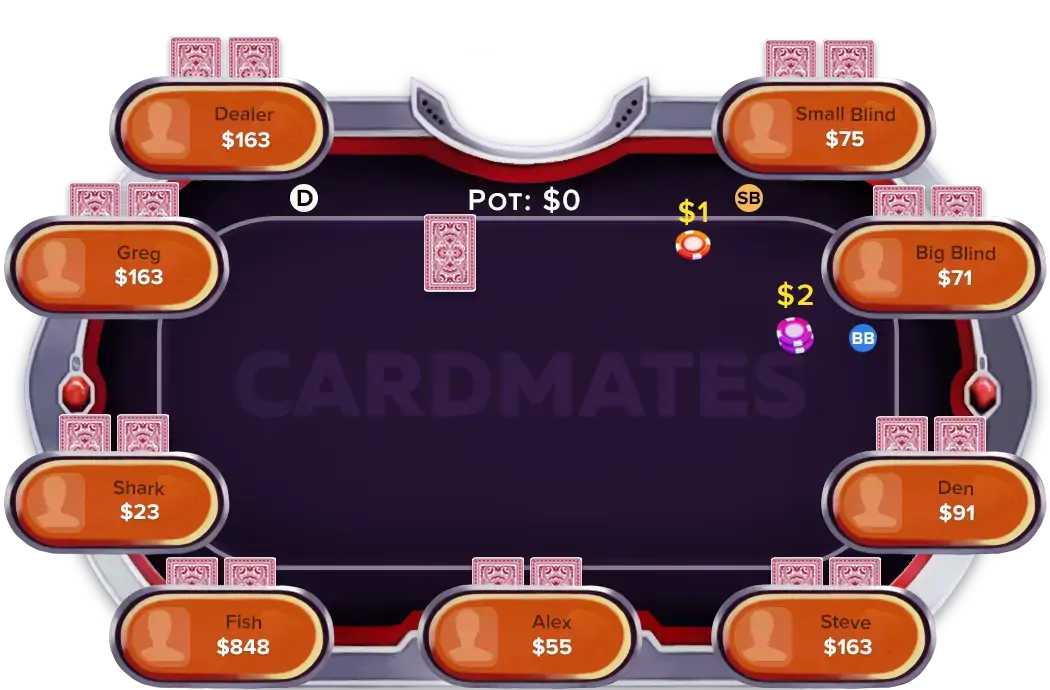
Once the blinds are posted, everyone involved receives two private cards. Omaha poker rules differ here: players receive four pieces but eventually use only two to build the hand.
What actions are available for players?
- Fold and exit the chase. No single chip will be lost.
- Put £2 into the pot to equal BB’s bet. That’s a call.
- Raise the current bet to £4. Equal the initial bet of £2 + add another £2 (min raise 1 BB).
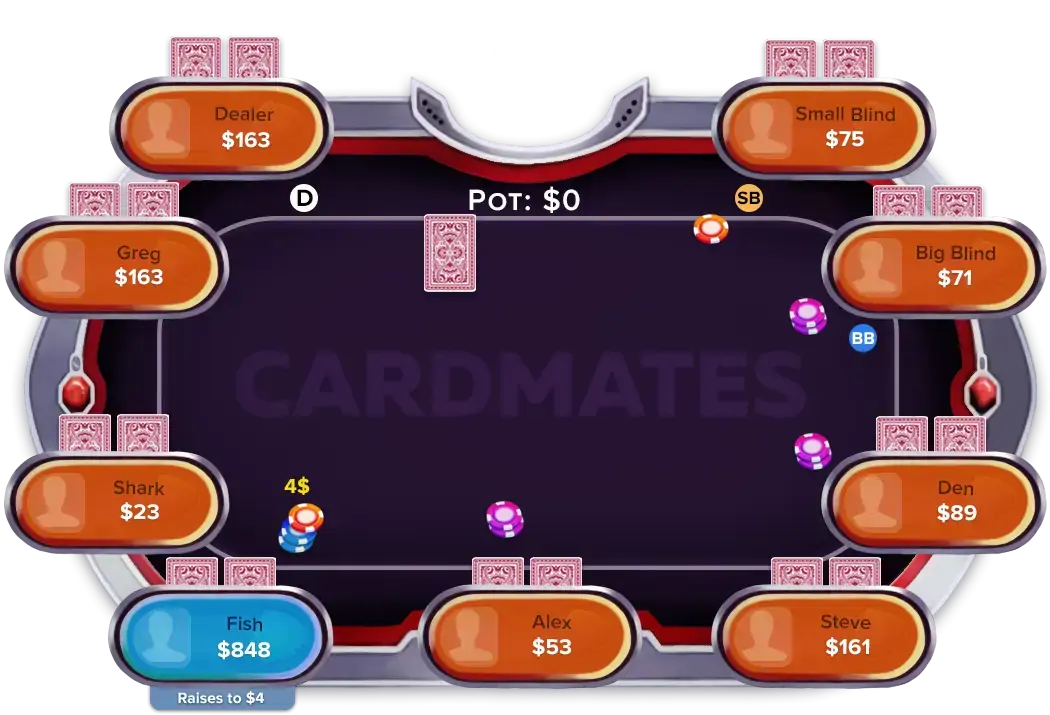
The individual sitting to the left of BB takes the first action preflop. This is an early position called UTG (Under the Gun); the last punters to act are SB and BB. The following moves are upon the SB’s consideration:
- Fold, losing £1.
- Call – match the existing bet (either BB’s bet by adding 1 pound, or one of the opponents’ bets).
- Raise.
Big blind has slightly more diverse options at this stage:
- Check (since they have already invested £2). Betting then ends, and the flop is dealt.
- Call if someone raised before them.
- Fold (though why give up when you can play check instead).
When someone raises, all other punters can opt for a call, fold, or reraise. The minimum raise is one big blind, which is £2 in this case.
The street finishes once every player has made their decision. One takes the pot if nobody calls their bet/raise. As a rule, players do not reveal their hand strength, but this is possible in home games. We personally do not recommend doing so, as your bluff may not work next time.

If multiple people remain in the game, 3 shared cards are revealed face-up on the table (they are visible to all participants) – this stage is called the flop. Subsequently, another phase kicks off, offering players the same options as the previous one plus the choice to check and skip their turn, passing it to the next participant in clockwise order.
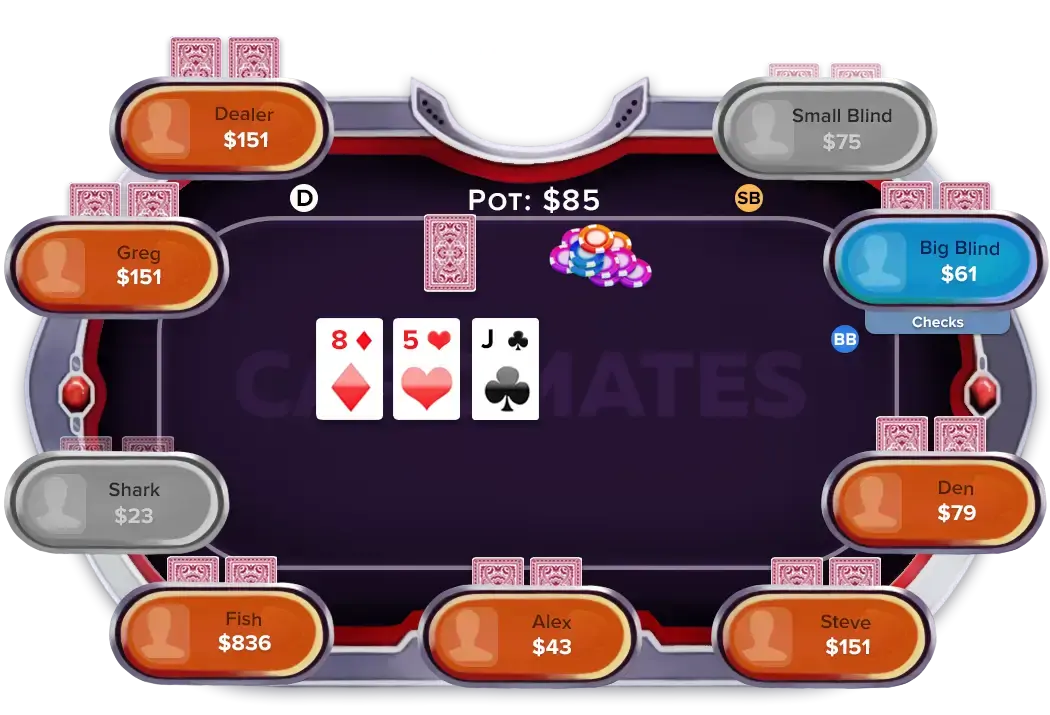

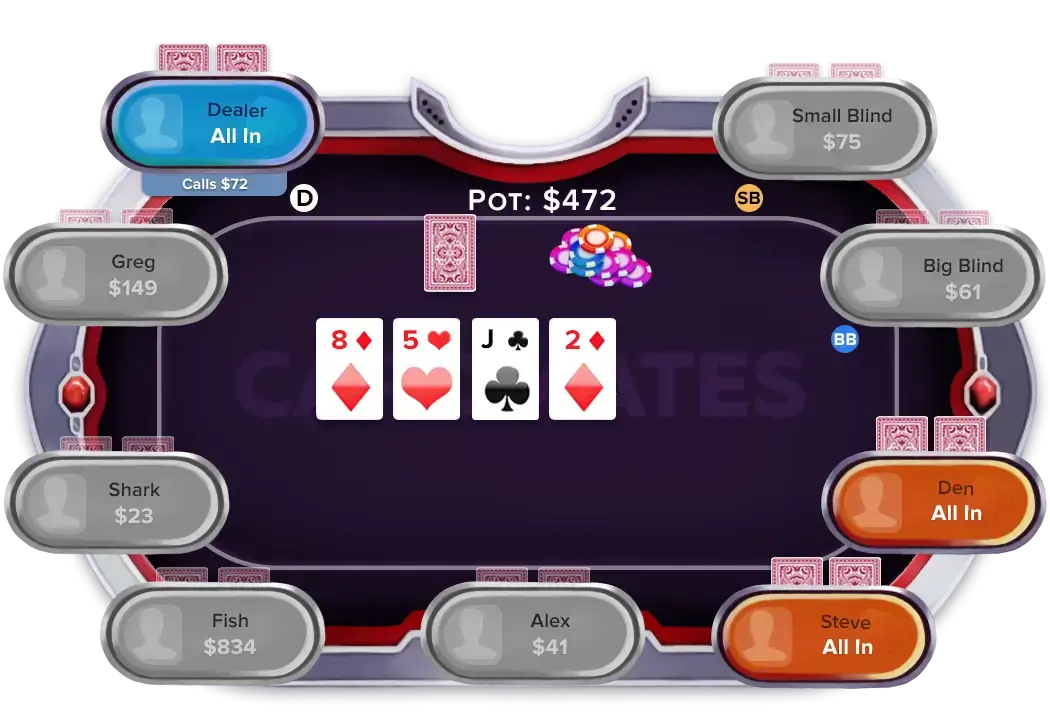
Once all players have acted, the fourth card – referred to as the turn – falls on the board. Betting goes on following the familiar scheme. At last, the fifth and final board (community) card, called the river, shows up.
Non-community card games have dissimilar play rounds but offer the same moves (call, raise, etc.). In contrast, Chinese poker rules exclude any streets. Punters collect points per properly grouped hands and royalties per exceptionally strong combos.
Showdown and Kicker
At this point, the finalists compare their combinations to determine the strongest one. A showdown, by the way, can occur in any round if all participants move all-in. In this case, the missing shared cards are dealt all at once. The way the champ is determined is identical.
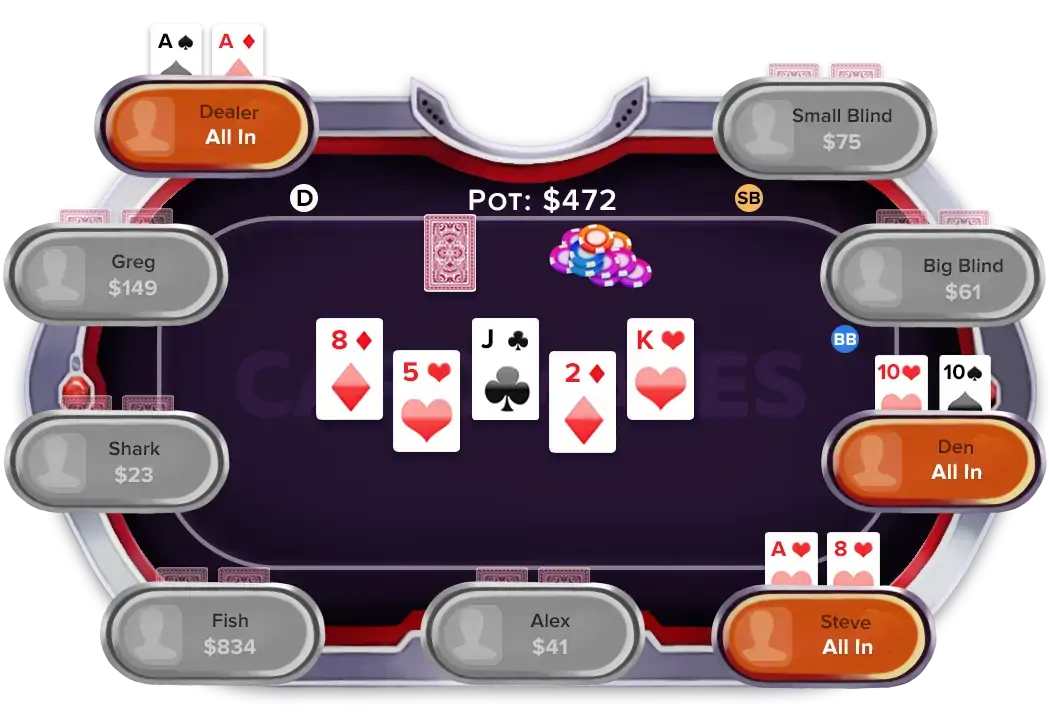
When the kicker steps in?
From time to time, there are situations where players collect equal-strength combinations. In such cases, Kicker helps determine a winner. It's the highest card in the set, which is not considered part of the hand.

Liam was dealt A-Q, while John received A-10. The board came down 7-J-A-2-J. Both players ended up with two pair (AA vs JJ), but Liam's queen kicker played to earn him victory. In the case of an identical kicker, they would have split the pot.
Key Differences in Poker Rules
Just as there are many points of similarity, all versions differ in their mechanics. Each has its own learning curve and twists. Exploring them, you’ll understand which variant suits you best and which you can keep for later.
Here's a quick highlight of the core distinctions across poker card rules:
Blinds vs Antes
The first element used differently is forced bets. Unlike Holdem and Omaha that both use the scheme of blinds (SB and BB), Stud poker rules feature an ante. It requires that all punters at the table pay an equal sum before they see their starting hand. Thus, pots are initially bigger than when playing with blinds paid by two people.
Forced bets also shift in variations where the deck drops from 52 to 36 cards. Everyone posts an identical ante, and the dealer seat puts in BB (aka “button blind”).
👉 See where else Short Deck poker rules differ.
These obligatory wagers speed up gameplay and promote a competitive atmosphere. Many overfold in the hope of getting optimal starters and refuse to fight for the pot with weak ones. Forced bets hinder players from passivity. Plus, they form the initial pot, ensuring winnings in every hand.
Private + Shared vs All Private Cards
Punters group hands from two starters plus three from the shared board in holdem/omaha. In Stud, the combination still includes five pieces. But part of the cards are private, and the rest are dealt face-up – visible to opponents. In the case of draw rounds, all cards are laid facedown.
See how poker rules differ in classic draw and its lowball variations:
| Game | Key distinction in forming hands | Detailed guide |
|---|---|---|
| Draw format | Each participant gets a set of 5 individual cards and has one chance to add strength to the holding. | 5 Card Poker Rules |
| 2-7 triple draw (lowball) | Punters receive 5 cards and can swap them three times. | 2-7 Triple Draw Rules |
| Badugi (lowball) | The initial set includes 4 cards, and players have three draws to strengthen. | How to Play Badugi Poker |
High-Hand vs Lowball System
Finally, two structures tell us how hands rank: high and low. Punters aim to get the highest-ranked hand in Omaha and Holdem. In contrast, Razz poker rules value the lowest possible one, built under specific conditions.
The mix of structures makes Omaha Hi Lo rules stand out. Here, people play to complete either the highest or the lowest hand, or both at once – a rare luck. The two winners enjoy equal parts of the pot. If someone scoops (builds both combos), the pot fully goes to them.
Poker Game Rules in Lesser-Known Variants
While Hold'em remains the top choice for most UK players, less prominent variations should not be ignored.
- Mixed experience
Skilled players who know rules of poker variants may put themselves to the test in HORSE. Here, punters progress through five rounds – each follows a new scenario. It’s challenging because blinds switch to ante and change back to SB/BB. In turn, hand values shift from high to low, or both count at once. The only thing that remains is the fixed-limit (FL) structure for controlled betting.
👉 Discover how to play HORSE poker in the proper order.
- Player vs Dealer
Most of the time, people play against other participants. If you seek diversity, our collection has Caribbean stud poker rules. The only opponent here is the dealer, and to face you off, they must have a qualifying hand (conditions vary). Having the house as your opposition spices up the gameplay.
👉 Learn how to play 3 card poker for an even more twisted gaming adventure.
- Alternative experience
Organising a party and thinking about entertainment? The game where participants guess the suit, colour and value of cards across multiple rounds works perfectly. If the party is for adults, Irish Poker drinking game rules may come in handy. When adding the drinking part responsibly, the gameplay will leave lots of funny and memorable moments.
👉 Find out how to play strip poker to spice up the party.
How Poker Rules Differ Between Formats
By way of organising gameplay, formats here can be divided into two types:
| Cash tables | Real money games played at specific stakes (you exchange 💵 for chips before joining the action). One can leave the table at any time. |
|---|---|
| Tournaments | You pay a fixed entry fee referred to as ''buy-in'' and compete for prize-winning places. |
- Buy-in rules in cash games vs tournaments
If the punter buys in for 150 GBP in a cash game, the total value of their chips will be 150 GBP. They can take the chips they have on the table after a few hands and receive an equal sum in cash back. People normally opt for a buy-in amount equal to 100 BB.
In tournaments, buy-ins are set at a predetermined size. The chip stack the punter receives at the outset doesn’t have real cash value. It’s just the paid right to participate in the event. You either lose the whole stack along the way or take down the tourney.
- Blind growth
Cash games do not involve blind growth, meaning that SB and BB amounts remain fixed throughout the play. Tournaments, on the other hand, operate differently. Blind levels increase at regular intervals set by a poker room, creating a more dynamic gameplay experience.
- Table stakes
This fundamental regulation works in cash games. The rule states that you cannot add a penny more once the hand is underway. You should only use the money/chips you started it with.
Tournaments equip each participant with an equal, fixed stack. Players can re-buy after busting under specific conditions and only when it’s allowed. Our top poker sites for UK players host plenty of freerolls. They are a perfect way to learn and see all the differences between the formats in practice.
How to Pick a Suitable Poker Format?
Understanding poker formats is most effective through personal experience. Many novices use free testing mode to figure out which is best for them: cash games or multi-table tournaments. That’s not the same as real experience, but it will help you see how each format feels to play and make a more informed choice.
Match it to your goals:
Goal | Cash games | Tournaments |
|---|---|---|
Level of risk | Low to moderate. | Rather high. |
Progression of blinds | None, blinds stay fixed from start to finish (until you leave the table). | Go up at predetermined intervals. |
Payouts | Each pot is a separate win. | Depends on the prize structure. Usually, the top 10%-15% of the field get paid. |
Time commitment | Flexible, the punter exits the play as they please. | Differs. Major tourneys can span 10–15 hours and even multiple days. |
Best for | Punters who value flexibility and want to control their session time. | Long-term competition. |
There is a middle ground: SNG (Sit and Go). These are fast-paced tourneys lasting 20–60 minutes, with the top 2 or top 3 being paid out. SnG format is perfect for those seeking tournament experience but not ready to commit to hours-long play.
Learning Poker Through Practice – Safest Ways
Practising the game is a natural next step after you get the poker basics for beginners and common rules. For something that realistically reflects what real money experience is, do the following:
- Play with friends. There are probably at least a couple of like-minded people around you to organise home games and have fun.
- Try free online stuff. Consider tournaments that do not require an entry fee – this will let you practice poker without draining your wallet. Check out Cardmates freerolls with real prize money that we run in collaboration with top UK operators. No massive fields due to password access.
- Play cheap cash tables. Micro-stakes are another safe way to learn how to play poker. Low limits minimise pressure and financial risk.
Regardless of which way you follow, only consider licensed platforms. Our recommended poker apps offer fair gaming under UKGC approval and thus exclude rigged outcomes.
Our Summary
Learning the rules of poker isn’t challenging if you know the basics and see the skeleton across different variations. We’ve tried to explain the shared and unique traits in a straightforward manner, providing both theory and practical examples. Exploring our guide will help you find the right games.
Once you get the hang of the poker basics, you can deepen your knowledge by exploring different strategies and software over time. Whatever stage you are at, remember to be responsible about your activity.
FAQ
❓ What are the basic rules of poker?
Basic poker rules require that punters bet on the value of their holdings. Each game starts either with blinds or with an ante. Once pocket cards are known, punters call, check, raise or fold throughout several rounds. The goal is to collect the strongest 5-card hand or win the pot behind others' folds.
👀 In which game are the poker rules the easiest?
Draw format has the easiest playing rules on a technical level. Everyone at the table pays the ante and then receives five individual cards. Next goes the optional card exchange, and the showdown. There’s no board, and this facilitates gameplay.
🎯 Do all rules of poker follow identical hand rankings?
No. Games with the shared board value high hands, while lowball variations stick to the lowest-hand system. Some games combine the two rankings and divide the pot between the holders of the highest and the lowest hand.
⭐️ How do the rules differ in community card vs stud vs draw poker?
In the first setting, people use the same board to collect their best hand. In stud, part of the cards are dealt face up, but participants do not share them. In draw games, all pieces are individual and only revealed at showdown.
🧩 How do no-limit, pot-limit and fixed-limit poker diverge?
No-limit format offers freedom in bet sizing. At fixed-limit tables, the player’s bet is capped by a specific amount. Pot-limit structure offers a balance by restricting wagers to the current pot volume. The cap increases with each round, where the pot grows.
💁♂️Which poker for beginners option is best: cash or MTT?
Cheap cash games are generally better. Each hand is independent, so the punter is allowed to leave at any time after they join the table, even if they only played one pot. Unlike in MTT, blinds do not grow, and there’s no bubble stress.