
How to Play 3 Card Poker - Rules, Hands and Strategy

3 Card Poker is an exotic, patented table game where the only opponent is the house, not other people. Here, Straight always outranks Flush, and Three of a Kind always beats both.
We’ll explain all nuances of the rules, regular wagers, side bets and their bonuses in our guide on how to play Three Card Poker. It also includes expert tips that help optimise statistical chances vs the casino, plus common costly slip-ups.
What is 3 Card Poker Objective?
The primary goal is to outplay the dealer with your 3-card hand during the comparison stage. There is no traditional betting: you either fold or commit chips and go forthwith to the showdown. Forcing the croupier to quit with bluffs and raises is unattainable, but you score an automatic win if they do not make the cut.
In Three Card Poker, each participant vies with the house rather than facing a bunch of foes.
That said, bonus wagers let the punter claim an independent reward. It's credited no matter how the clash versus the croupier ends.
3 Card Poker Rules: The Basics
This format requires the same-old deck with 52 units (without jokers). A combination is a set of three cards, as implied by the pastime’s name. Similar to Caribbean poker rules, there is no shared board, and no possibility to exchange what you’re holding.
More details on how to play 3 Card Poker:
- Accommodation. The number of boxes (seats) is limited, so no more than 6 people can recreate at one table. Being the only active gambler, you are allowed to take up several spots, that is to say, run multiple games simultaneously. In this case, your stakes can differ across each individual box.
- Regular bets. This discipline basically combines two "matches", or rather, bets – Ante and Play. Everyone has the freedom to choose how they want to proceed: place an ante only or take advantage of both wagers (it's entirely up to them). Their sizes are typically identical, but some casinos have exceptions. Therefore, it is better to clarify all the specifics before joining the table.
- Side bets. These stakes are independent from the main mode versus the croupier and offer bigger prize payouts for clearly defined hands. Widely common are Pair Plus and 6-Card Bonus, but there may also be alternatives to progressive jackpots.
Dealer Qualification in 3 Card Poker
To qualify, a dealer must hold a Queen, King or Ace – that’s one straightforward requirement. Otherwise, they automatically lose that hand. From our experience, this is where beginners get confused and do not get why bets are returned if their cards are weaker.
Let’s consider a simple example:
- House: 5♣-J♦-10♥
- Hero: 5♥-10♠-9♣
Although the Hero’s Ten-high ranks below the house’s Jack-high, J is lower than the required Q to qualify for the exposure and comparison. This specific rule gives punters an added advantage.
Mathematical Advantage (House Edge)
The casino’s built-in advantage in 3 Card Poker alternates by wager:
- Ante only – 3.37% or around that;
- Play risk (total investment) – 2.01% with optimal strategy;
- Pair Plus – 2.32%
For other bonus wagers, the edge can climb toward 7%, 10% and up to 25%.
Hierarchy of 3 Card Poker Hands
Combinations, their strength, and the number of elements in a set deviate from traditional disciplines. There’s also a slight shift in hand rankings due to mathematical probabilities. But Ace serves as both low and high value, like in Holdem.
Here’s what you can collect in 3 Card Poker (top to bottom):
| Combo | Explanation | Like this | Probability |
|---|---|---|---|
| Straight flush | Three suited, adjacent cards | Q♠K♠A♠ | 1 to 454 |
| Three of a kind | 3 exact ranks. | 7♠7♣7♥, Q♥Q♣Q♦ and so forth | 1 to 416 |
| Straight | Three off-suit elements in consecutive order. | T♦J♣Q♥ | 1 to 30 |
| Flush | Any 3 suited cards. | 7♥ T♥ K♥ | 1 to 19 |
| Pair | Two identical values + one random value. | 4♠4♣A♦, J♣J♥7♦, K♥K♠9♦ | 1 to 4.9 |
| High card | Nothing collected. Three elements are not connected in any way; the top rank is taken into account. | T♣5♦3♠ (ten high) | 2.85 to 1 |
How to Play 3 Card Poker – Ante Game

A gambler makes a mandatory contribution, Ante. As usual, the range of possible sizes is quite wide, and everyone selects a comfortable one.

Next, the dealer – either real or virtual – equips you with 3 cards (face down) and lays out their own set the same way. We remind you that it's impossible to swap your hand if you are not satisfied with it.

Evaluate your combo wisely.
Got trash? Throw away and test your luck in another round. If you believe that your holding is strong enough to continue, another bet must be added to the pot. It tends to be as big as the Ante posted before dealing.

If the dealer meets the criteria, flip combinations over and see how they stack up against each other. The rules for 3 Card Poker outcomes and hand hierarchy mentioned earlier govern the winner.
How Winnings are Typically Paid Out
Ante game involves both standard and bonus rewards. Regular payouts directly depend on the gambler's and croupier's hands, as they are assessed to figure out who wins.
In the base game, rewards are paid out as outlined below:
- Dealer is out. Ante is awarded 1:1, and the second stake is refunded in full.
- Dealer qualifies but ranks below. Cards meet the requirements, but they are weaker than yours. Both regular bet and ante are granted 1:1.
- You lose the pot. Since the house ends with a superior hand, you get wiped on both wagering amounts.
- Tie result (stand-off). There’s neither a winner nor a loser. In this case, you receive all the money spent in this round back to the stack/balance.
⚠️ Popular misconception in Three Card Poker rules: We’ve noticed that newbies usually think they profit from both wagers if the dealer misses the qualification. But the Play wager doesn’t double unless the croupier passes and loses – it just returns to your stack.
Ante Bonus Payouts
This extra payout does not predicate upon your rival's holding at all. It is awarded on top of the standard win if the punter builds any of these combos:
| Hand | Typical payout |
|---|---|
| Straight | 1 to 1 |
| Three of a kind | 4 to 1 |
| Straight flush | 5 to 1 |
Payouts in Pair Plus Round
In fact, "Pair +" is a sort of a prop bet that the punter will get at least a pair (any value) or better. Dealer's cards are not taken into account in this spot and cannot affect the hand outcome.
When your combo is worse than a pair, the casino takes away your Pair Plus bet, and a new round begins. If you’re dealt a qualifying something, gameplay follows the same steps as the above-mentioned sample ante.
Pair + Paytable
| Qualifying set | Typical payout |
|---|---|
| Pair | 1 to 1 |
| Flush | 4 to 1 |
| Straight | 5 to 1 |
| Three of a kind | 30 to 1 |
| Straight flush | 40 to 1 |
3 Сard Poker Strategy: How to Play Optimally?
Strategy is very easy to understand because this game is more of a lucky coin than a complicated strategy, counting outs, and the ability to read opponents to get an edge over them. In fact, all you have to do is learn which hands you should and should not continue with.
Thinking about whether to make a Play bet? Proceed when your holding contains Q-6-4 or something stronger. E.g., King/Ace high or a pair, flush, three of a kind, etc.
Should you ever fold in Three Card Poker? Obviously, it’s advisable to fold anything weaker than Q64 and hope for heavy cards next time. If you enter the game with, say, Q-5-4 or worse, you risk losing your initial wagers (if the dealer cracks you) and Pair Plus if such has been made.
Common Mistakes in 3-Card Poker (Real Cases)
We also want to warn you and discuss a few verified cases from iGaming forums and our personal experience. Check these common beginner’s mistakes and avoid them in future:
- Opening too many hands. Never place the Play bet blindly – that’s a fatal mistake. A large portion of holdings have a zero chance of winning, so you will feed the casino's edge. Always evaluate your strength before you decide to carry on or quit the round.
- Falling for side bets. More juicy payouts are tempting, but that’s often a big trap. Chipping in more on Pair Plus and other possible bonuses than on the regular option noticeably fuels the house edge to 7%-8%. Plus, you're not immune to long dry streaks where you do not hit the required combination and thus drain the stack quickly.
- Using progressive betting systems. Martingale and similar schemes are irrelevant in 3 Card Poker. Just consider: you will already have to make two wagers each time you go on, which escalates the series of losses at double speed. Hence, if you start at £5 and then lose three games straight, your next Ante would be £40, plus a £40 Play stake. There’s also a risk that the table limit will collapse the doubling before you win anything back, something that is not guaranteed at all.
- Making stakes to recoup. This may quickly deplete your bankroll and speed up negative returns. Avoid reckless behaviour in the heat of the moment and never act on emotions – maintain composure at all times.
A Few Hand Examples to Consider
Example #1
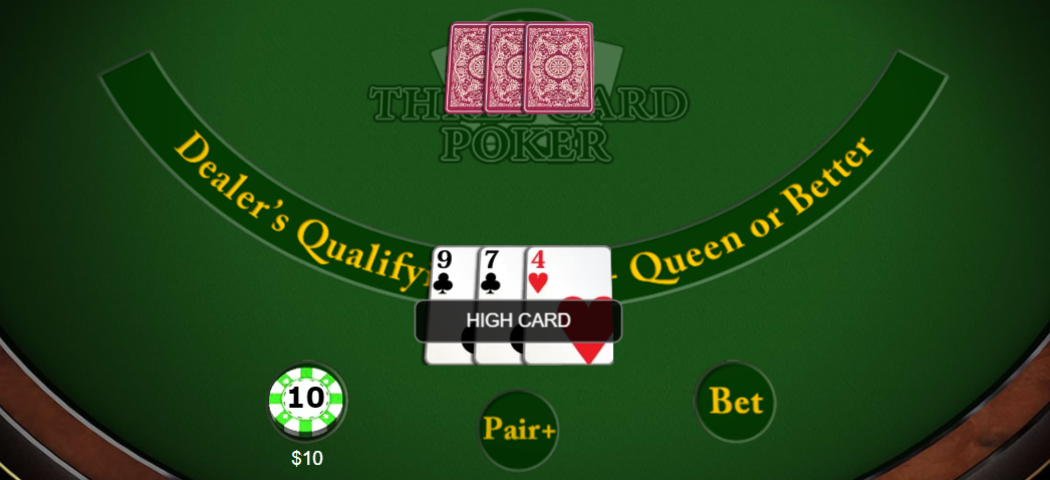
Hero pays a $10 ante and receives a frankly weak hand – 9♣7♣4♥. In such spots, it's best to end the round immediately, and that's exactly what Hero did. They only lost ten bucks (i.e. the mandatory entry).
Example #2
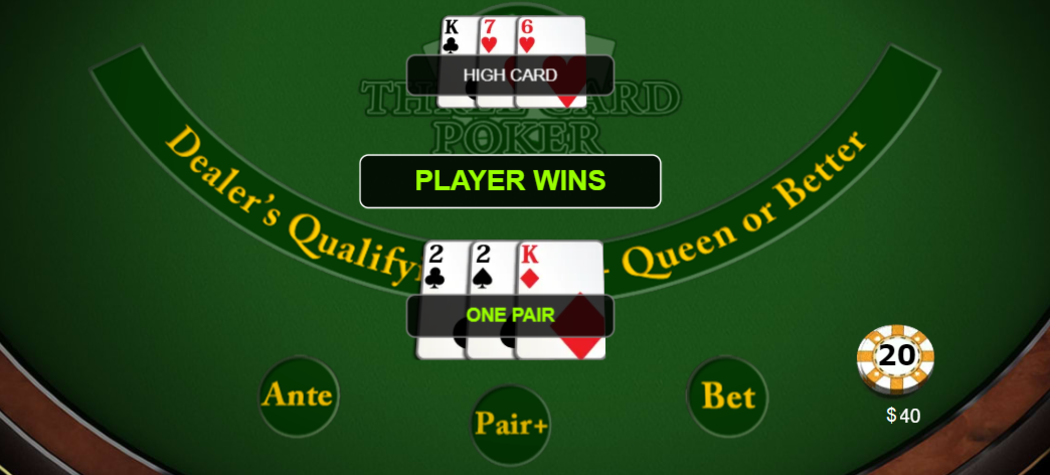
Hero places two bets (Ante and Pair+), each amounting to $10. They are dealt 2♦2♠K♣, meaning that their Pair Plus works out due to a pair of deuces. Hero chooses to go ahead by chipping in another $10 (total input – $30). The dealer flips over their cards, which turn out to be weaker (King-high). Luck is on Hero's side, and their net winnings count $20 (pair + reward and standard prize money for victory).

If you find the gameplay boring and monotonous, try mixing it with some other format, e.g., strip poker. This option is, of course, not suitable for public performance, but it can be an entertaining activity for home recreation. Major rule: all participants must be consenting adults!
Key Takeaways From Three Card Poker Rules
- No shared board – here you won’t find typical flop, turn, and river.
- To win, you need to beat one dealer, not 2-10 other opponents.
- If you give up, you only lose the first Ante stake.
- Straight has power over Flush, and Three-of-a-Kind sits above both.
- The house must have an eligible minimum: Queen-high or stronger.
- Neither bluffing nor complex strategic techniques are relevant.
- The best strategy for 3 Card Poker is to use a Q64 scheme and play responsibly.
Prefer to beat opponents with pressure and raises? Then you might find the variation of Short Deck Poker enjoyable.
FAQ
📜 What are the basic rules for Three Card Poker?
Things are running in the "gambler vs croupier" format. You chip in a comfortable Ante before the deal, get three cards and analyse them, then decide to fold or pay another bet and continue. Compare your strength with the dealer to know who wins. Payouts are derived from predetermined odds and bonus conditions.
🌐 Where can I play 3 Card Poker online?
This format is featured in many online casinos regulated by the UK Gambling Commission (UKGC). Such sites have strong security and offer rewarding bonuses and quick payouts. Poker platforms, e.g., Partypoker and 888, do not serve this kind of entertainment. But everyone will find them when switching to their dedicated “Casino” area.
🍀 Is 3 Card Poker all luck?
For the most part, yes. Punters do not control random outcomes, and the house always has a mathematical advantage. There is no shared board or opportunity to exchange cards, bluff, or employ other strategic manoeuvres. The only skill a punter can develop is when to stop (Qx6x4x rule) – this reduces risk and improves odds.
💡 How to reduce the house edge in this game?
To reduce the casino’s edge in Three-Card Poker, forget about side bets and throw away anything worse than Q-6-4. By following the advice, you give yourself an optimal statistical chance in the game. However, you will still play against 2.01% HE because it is impossible to eliminate it entirely.
👀 How do 3 Card Poker and 3 Card Brag differ?
These pastimes use different hand ranking hierarchies. In Brag, the best possible combination is a triplet (aka "prial"), and it overpowers a straight flush; a regular straight ranks below a flush. Also, there are no extra stakes, and punters go through one betting round after they pay the initial contribution.
🧩 Who invented the game, and when did it happen?
Derek Webb, a poker enthusiast from Britain and former proprietor of Prime Table Games, invented 3 Card Poker in 1994 (protected by patent rights in 1997). Yet, it was first introduced at the Grand Casino Gulfport in Mississippi, USA. This information can be easily proved on Wikipedia.






Please, login or register.