
Pai Gow Poker Rules: Guide & Strategy

Pai Gow rules are very different from classic poker, which most of you are used to. Below, you will find a step-by-step ruleset on how to play Pai Gow, how combinations rank and their probabilities. Along with rules, you also get conservative and aggressive strategy advice on how to arrange starting cards to win, with examples.
Basic Pai Gow Rules & Setup
- The game requires a 52-card deck and 1 joker.
- Everyone is awarded seven cards, and only the punter can see them.
- They should divide them into 2 holdings. The high hand includes five, and the low hand contains two.
- The front must not be stronger than the back. Otherwise, you will automatically lose (foul).
- The dealer also divides their set of cards into 2 groups and shows them to the foe.
- If both your holdings are more powerful than the dealer's, you win 1 to 1 (due to the casino commission). If one is stronger than the dealer's, that’s a draw, and the player gets their bet back. The house claims the full pot if you fall behind.
- Joker completes royal flush, straight flush, flush, and straight where necessary. Joker may serve as an Ace. In the front (low array), Joker = Ace.
Only one thing matters in Pai Gow poker: whose cards are stronger.
This game is a great opportunity to have a good time without worrying about your gaming skills. Luck plays a key role.
New to the pastime may even ask the croupier for advice about a Pai Gow hand, but this is only allowed at the beginning. The dealer will definitely help.
To get how the Pai Gow rules work for sure, watch this video:
Hands Ranking in Pai Gow
The hand value ranking in Pai Gow has many common traits with conventional poker. The distinction: the A-K-Q-J-10 is the nut straight, then goes A-2-3-4-5. Next, the order is standard (King-led, Queen-led, etc.).
Pai Gow has a royal flush of 5 aces, where Joker acts as the 5th card.
This combo is the strongest in the game overall, and the best combination in a low set is A-A.
Paired cards are usually seen as follows:
- Broadway – JJ, QQ, KK, AA;
- Medium – 77, 88, 99, 1010;
- Small – 22, 33, 44, 55, 66.
How Combinations Rank in Pai Gow Poker
| Combo | Description |
|---|---|
| 5 of a kind | AAAA + Joker |
| Royal Flush | A, K, Q, J, 10 – all match in suit |
| Straight Flush | 5 suited cards go in sequential order |
| 4 of a Kind | Four repeated ranks |
| Full House | 3 of a kind and a duo |
| Flush | Any five from the same suit |
| Straight | 5 offsuit pieces in sequence |
| Three of a Kind | 3 repeated ranks |
| Two Pair | 2 sets of identical values |
| One Pair | A duo |
What Wins (Example)
Hero gets 6-7-8-9-10-A-A. They arrange aces in the low row (which forms a pair). 6-7-8-9-10 (a straight) moves to the back.
The opponent’s combo: 2-2-2-A-K-4-5. They put A and K in a secondary hand. The remaining ones go to the main, where 2-2-2 form the triplet. Thus, both combinations have an advantage, and Hero is the winner.
Pai Gow Hand Probabilities
Punters have to consider the likelihood of getting certain combos.
| Hand | Probability |
|---|---|
| Straight or royal flush | 0.137% |
| Four of a kind | 0.2% |
| Full house | 2.7% |
| Flush | 4% |
| Straight | 7.3% |
| Triplet | 4.8% |
| Two pair | 23.1% |
| One pair | 41.7% |
| High card | 16.1% |
The table shows that the odds for a strong holding are quite good. The general probability of winning is actually much better compared to other casino games, even without any complex strategies. E.g., the chance of hitting Quads in Pai Gow is 0.2%. Those playing Texas Hold’em can build this combo with a 0.00025% probability.
The percentage probabilities clearly show where the punch line is:
- Draw: 41%
- Hero’s victory on both sides: 29%
- Dealer’s two-way victory: 30%
Pai Gow Poker Strategy Approaches
To achieve the greatest advantage in Pai Gow, UK punters can use two different poker strategies – conservative and aggressive. Let’s examine these approaches in greater detail.
Conservative Strategy
The biggest thing in Pai Gow is to understand how to separate your starting cards correctly. Below, we will consider the basic rules of splitting different combinations according to the conservative approach.
One Pair
In case you happen to receive two of a kind, always keep them in the high row and locate the top cards in the low row.
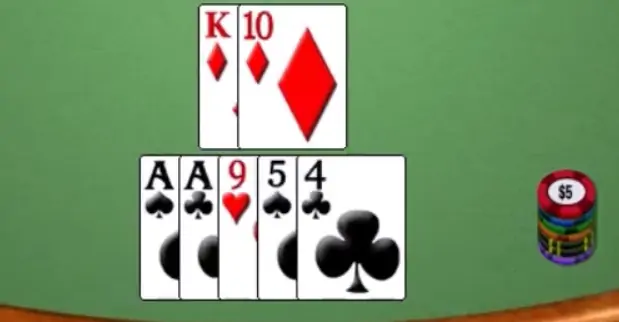
Example. Suppose you got A-A-10-K-9-5-4 as your starter. Hold AA in your power hand and put the King and the Ten in the other. This is the smartest way to break the initial 7-card combo.
Two Pair
Here are some useful tips on playing two pair in Pai Gow Poker:
- If both are composed of 6, 5, 4, 3 or 2, it is advisable to leave both in the high line; otherwise, position the smaller out front. With an ace and two matches that are 7 or worse, keep A in the low line and both duos in the back. Separate them and leave the weakest value up top in all other spots.
- Got A? Move it to the front row and hold the two pair in the back in the subsequent situations: the top duo is 10 or better, and the small is 6 or worse. In all other cases, separate them and move the weakest to the support combination.
Three Pair
Position the nut out front, and the other two at the bottom.
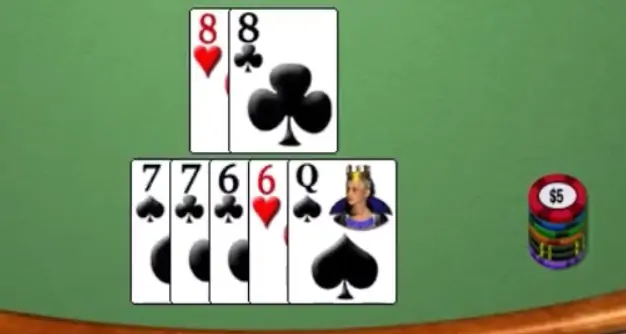
Example. Suppose you are dealt 7-7-6-6-Q-8-8, which gives you three pairs: sevens, sixes and eights. Two small (6-6 and 7-7) and one medium (8-8). The cards are not really strong, but you can keep 66 and 77 together in the back and move the high up top to attempt to win both combos.
Three of a kind
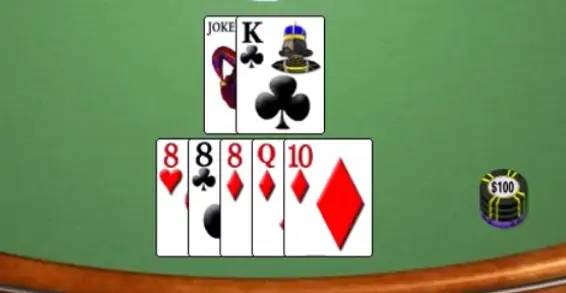
Position it in your main hand (unless these are aces), move the two best values to your secondary hand. Hold A-A-A? Separate them.
Straight
When you have a straight and two repeated ranks, drop the straight for the high hand if each duo is 9 or worse. Separate the straight and put the smaller duo out front if they are 10 or anything up. The top pair, in turn, should be positioned in the back.
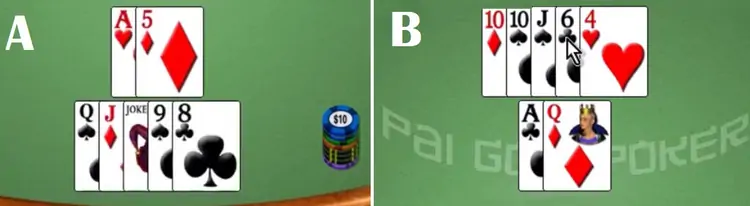
Example. Let's discuss the following spot:
- Your set: Q-J-A-5-9-8 and a Joker (picture A)
- Dealer's set: 10-10-J-6-4-A-Q (picture B)
Here, you have a "gutshot straight draw" of Q-J-9-8 but zero chance of finishing it later. However, the Joker can substitute 10 and thus help you build the straight. Therefore, hold the straight in the back and play A-5 in the low hand.
Now, let's consider your opponent's holding. The dealer moved 10-10-J-6-4 to the high row (which gives him a duo of tens) and placed A-Q in the weaker row. Your straight beats the dealer's 10-10, but your A-5 loses to their A-Q. This is a push (tie), and the outcome returns your bet.
Flush
This is a very powerful hand in time-honoured poker, but things are different in Pai Gow. You will sometimes need to separate it:
- Hold suited cards as your high unless there are other combinations.
- Have an extra flush card or all seven match in suit? Use the strongest of them (or the two strongest) to set a low row.
- With a flush and duplicates (9 or worse), it’s advisable to use the suited run in the back. If they are 10 or better, split the flush and play the smaller duo in the front, while moving the stronger to the bottom.
Full house
This combo should be separated: hold triplet in the main array, placing the duo up top. With two pair and trips, arrange the strongest duo in the secondary array.
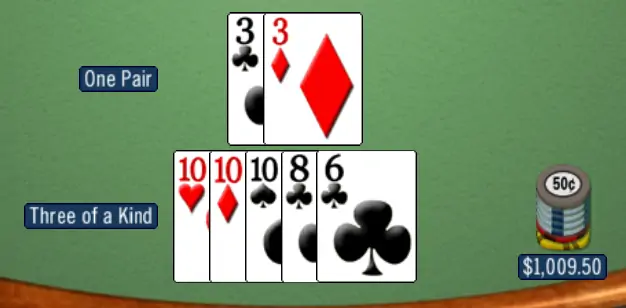
Example. The 10-10-10-8-6-3-3 starter secures a full house. You could win a huge pot with this combo if you were at the Holdem table. But here, divide it, placing 3-3 up top and 10-10-10 in the back.
Quads (Four of a Kind)
Eight or worse? Position them all in the back, then choose the two finest cards out of the rest and move to the low hand. If they are 9 or better and there is no A or other duo, split four of a kind and arrange duplicates in different arrays. When these are nines, and there is an A or twosome, keep all nines as your high. Then position the A out front.
Always separate AAAA to play them in different hands.
Five Aces
Separate them, moving two to the top combination.
You may think that there is a mistake as the poker deck has only 4 aces, but everything is correct. It should be remembered that Pai Gow Poker uses 52 cards and one Joker, which is considered an A in most situations (except for straight, flush, and their mix).
Aggressive Strategy
The aggressive approach has different solutions for separating combos. Let's take a closer look at these differences.
Two Pair
5 or worse? Hold both in the high set; otherwise, place the smaller value out front.
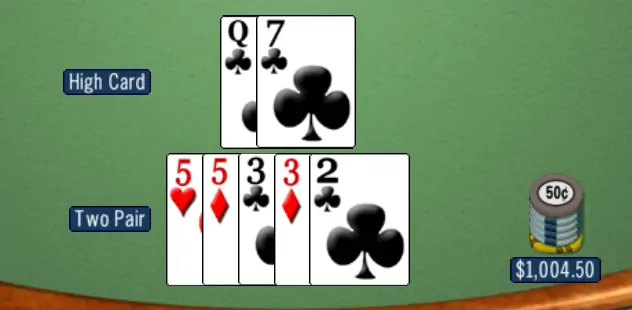
Example. Assuming you receive 5-5-3-3-Q-7-2. This isn’t the best starting set, but you can split it in a way that will give you some chances to win both combos. Therefore, use Q-7 as your low and keep 5-5 and 3-3 in the bottom as guided above. If you had one pair better than 5, for example, 10-10 or K-K, you could put the smaller value in the upper set and play the top in the back.
For of a Kind
7-7-7-7 or worse? Assign all sevens as your high. If they are eights or better, separate them, placing 77 up top and the other sevens in the back. When you have four eights or better with an ace or another duo, then position all 4 cards in the main array while moving the A or twosome to the top.
Straight, Flush, Straight Flush
There’s a choice between straight, flush and their mix? Pick the combination that lets you move the two strongest values to the low array.
Example. You sit with Q-10-9-8-K-A and a Joker – all the same suit (spades). There are two options to separate them effectively:
- Keep the Q-led straight flush in the bottom and leave K-A in the top.
- Move A and Joker to the top hand and hold K-Q-10-9-8 in the back, but it would be less powerful. Two aces (A and Joker) are stronger than K-A.
Both options are suitable and give you solid chances to win on both sides.
Playing for the Bank
When you are taking the banker position, you have a great edge over your opponents. This advantage manifests in the next situation: if participants collect the same combos, the banker wins. Therefore, it is advisable to play for the bank whenever possible: when it's your turn to act and when other punters refuse to do so (you have enough bankroll). This helps reduce the casino’s edge to 0.25% and sometimes even lower.
Important: During the first round, the banker's duties are performed by the dealer. After that, any participant is eligible to act as the banker intermittently.
Our Summary
As you can see, Pai Gow is not a difficult pastime, especially since it has the main advantage – you need to fight against only one foe. Those who want to win in this poker format should study the Pai Gow strategy. But bear in mind that by applying the conservative method, your play will be smoother and often result in a tie, while choosing the aggressive style, action will be more dynamic. Good luck, everyone!
FAQ
🧩 Who created Pai Gow poker?
Fred Wolf created the Pai Gow game in 1980. Although it has some traces in Chinese dominoes, this is an American pastime. But the nature and origins make gamblers consider it an Asian poker variation.
🎯 How does Pai Gow differ from classic poker?
Its key difference is that the punter needs to outdo only one rival, represented by the dealer, whereas in a traditional format, you act against several foes. So, it won’t be a problem to learn how to play it even without previous experience in poker.
🪙 What is the house edge in Pai Gow games?
Casino’s advantage: 2.5% with optimal strategy. In some Pai Gow variations, it may be slightly above or lower. Being the banker helps drop the percentage to 0.04%-0.25%.
🌐 Where can I play it online?
Traditional poker sites do not offer this game, but you will find it in most UK-regulated online casinos. That’s because rules require you to battle against the house (dealer) rather than other people. Even if several punters are at the table, everyone compares their cards with the croupier.







Please, login or register.