
7 Card Stud Poker Rules and How to Play

Stud poker is considered one of the oldest card games on planet Earth. This article focuses on the commonly played version – 7 Card Stud poker. From our guide, you will quickly learn detailed rules, as we have explained them in plain language. It reveals major features and beginner’s misinterpretations. We also share some basic and advanced recommendations for playing it, so that you hold your own against more skilled opposition.
What is Stud Poker?
Stud is an old poker game format played without a flop and community cards. The rules swap them for three concealed and four exposed cards that punters collect during seven streets. The hidden part is their pocket hand, whereas the visible part is their individual board that’s out in the open. This game typically seats a group of 2 to 8 people, and whatever the eligible count, they use a casual 52-card deck.
7 Card Stud is the dominant variant in the family – a real crowd-pleaser.
Other popular types: Razz (lowball version), Stud8 (Hi/Lo) and Caribbean Stud.
For the record, Stud is an important part of the so-called mix games – the format that combines several different disciplines. HORSE poker is considered a big hit, and the game in this mix is presented as the last two disciplines out of five: the one we’re now discussing and the hi-lo variant.
Detailed Rules for 7 Card Stud Poker
The object: A person gathers seven cards within one gaming loop and should use 5 to complete the best combination. Any blend of hidden and visible ones is acceptable. Success requires tracking your foes’ upcards through the streets, so this is also a game of concentration.
How to Bet at Stud Poker?
The discussed version is suitable for playing in three different betting formats:
- Fixed Limit
- Pot Limit
- No Limit (almost never used)
Based on tendencies, fixed limit structure is the most common setting. A full-length deal consists of 5 betting rounds: in the first two people play with small bets, and in the subsequent ones, they put in a big bet.
Our Example: In a £4/£8 FL game, the small bet will be £4 (paid on the 3rd and 4th streets) and the upper bet will be £8 (paid on the 5th through 7th streets). Plus, there’s a cap on four raises within a round, which is where punters who would play NL format lose track.
Who Places Antes and Brings In?
Before anything rolls out, all accommodated at the table must chip in a poker ante bet. It is obligatory, regardless of whether you’re playing Stud poker online or offline. Typically, the ante is 10% of the table’s upper limit – it’s £0.80 in our example.
Then, the opponent whose first upcard (termed “door” card) has the smallest value overall gets the ball rolling with a bring-in. It is an additional contribution, but none, except the just-mentioned punter, pays it. Bumped into a tie with one or two foes? The lowest suit breaks it.
In Stud poker, spades are top-ranked. Then go hearts, diamonds, while clubs are at the bottom and dictate the bring-in donor.
⚠️ Common mistake: From our experience, many people mix up rules while selecting who should bring in. Here, it’s the holder of the weakest door rank, while in Razz, the responsibility lies with the top door.
Hand Rankings – What Beats What?
Combinations and their seniority are both regular. Those transitioning from Holdem will not need to learn a new order or anything, they’ll be familiar. It therefore follows that Royal Flush is sitting at the top, whereas High Card is the least powerful lineup in the hierarchy.
Everything in between is ranked as expected: Two Pair beats a Pair, Flush loses to Full House, and so forth.
If someone needs to refresh their knowledge on established poker hands, we have this information on a separate page.
How to Play 7 Card Stud Step by Step
- Everyone involved pays a mandatory bet, namely an ante.
- The dealer lays out a set of three cards in front of each seat.
- The owner of the lowest visible value contributes their special wager.
- The rest of the playing group arrive at a decision in turn.
- All punters add one card to their open board.
- The previous step repeats twice, without any changes.
- The game ends with a showdown, where comparison discovers the winner.
See how to play Stud poker through all stages in more detail:
Forced Bets and the Third Street
Each in the bunch receives three cards: two closed and one open. Who has the weakest upcard continues with the bring-in bet. If several people appear to have equal-ranked low cards, the suits step up to resolve who bets – the weakest status does it.
7 Card Stud poker rules state that suits are arranged alphabetically. From lowest to highest, they rank: Clubs, Diamonds, Hearts, Spades.
Example:
- Hero: x x 5♣
- Opponent: x x 5♥
Here, Hero should bring in because they have a weaker suit (hearts go over clubs). This punter has two options: to put in a bring-in equal to the ante contribution, or to boost it to a small bet. Participants who act next can fold, call, or raise.
Fourth Street
How do you play Stud poker next? Each player who remains eligible in the deal adds an open card to their individual board. The first word belongs to the highest exposed rank.
Example:
- Hero: x x 5♣ 10♥
- Opponent: x x 5♥ 8♣
In this case, Hero has the first word because 10 outranks 8.
Fifth, Sixth and Seventh Street
Those who keep playing the deal receive another upcard. The opening move is made by the strongest combination exposed, and this will be the main betting order until the final point. The price doubles to one big bet from the 5th street forward.
On Sixth Street, the next open card is dealt to the surviving contenders. At this point, everyone holds five cards, and three of them are visible to the opposition.
The dealer passes the last closed card to active seats, and the final betting round subsequently starts. You shouldn’t expect any shifts in how things unfold – all the same conditions apply.
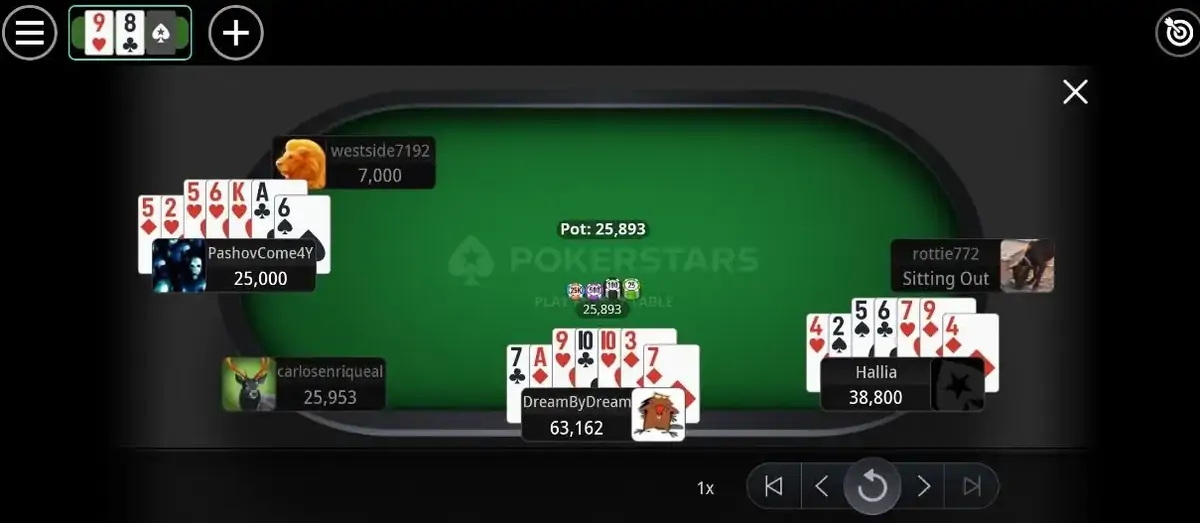
Once everyone’s bets are in, things move on to a showdown. As the winner is announced, a new gaming loop begins.
Stud Poker Rules for Showdown – Who Gets the Pot?
Here are a few bullet points you need to be aware of in terms of showdown:
- The surviving punters expose their holdings and compare them immediately.
- The owner of the strongest poker combination leaves with the pot.
- If you see a few flushes or straights, the first point of evaluation must be the top card rank. If yours is lower than the rival's, you lose.
- Two players with the same-value hand split the pot, regardless of suits.
⚠️ Common mistake: Suits have no power at showdown and so are not taken into account in the event of a tie. Newbies often misinterpret the rule when they compare spades with diamonds and everything in between. It only works to decide the bring-in player.
Basic & Advanced Strategy Recommendations
Now, we want to share a set of quick pointers and tips for a successful Stud poker game. These are based on surveillance we’ve made over time.
- Know when to wrap things up. When you see you’re chasing losses rather than playing with a cool head, quit immediately. Responsible play is the number one priority, as it prevents throwing money away. And overspending is what exactly happens when frustration and tilt govern your betting – the most non-optimal strategy ever.
- Change how you play based on when you act. Not a new thing, that “early position” gives minimum information and requires a tighter play. “Late positions,” in turn, are prospects for more correct moves where you reduce losses and increase wins. Adjusting behaviour as the game goes on is a winning strategy.
- Steal antes and bring-in bets. Total bluffing will hardly work to get dead money, but clever semi-bluffs have all chances to be successful. Put pressure with strong draws that can improve on 4th street in case someone calls. But then, in home games without antes, risking a full bet to win a tiny bit will be a bad idea.
In Stud poker, every “dead” card (folded one) changes your odds of winning in the deal.
Starting Hand Considerations – Keep in Mind
Prefer strong starters over secondary strength, especially at the very start of the journey. Strict hand selection makes the background for staying profitable over time.
Check the best starting hands in 7 Card Stud:
| Hand | Example | What makes it strong |
|---|---|---|
| Rolled up trips | A-A + A, K-K + K, etc. | A made triplet that often wins at showdown, plus chances to make a full house or quads. |
| Three suited high cards | A♦-K♦ + Q♦, K♣-Q♣ + J♣, Q♥-J♥ + T♥ | Premium holdings that can become nut flushes and high pairs if live. |
| Three high cards (offsuit) | A-K + Q, K-Q + J, Q-J + T | Potential for nut straights and high pairs if live. |
| Big pairs | A-A + J, K-K + T, etc. | Hold up well against most foes – the bread and butter. |
If you need a handy poker cheat sheet for conventional games, see our designated page with multiple preflop charts.
Three Advanced Tips From Cardmates Experts
- Watch the muck. You hold a pair of queens and need one more Q, but the rest have been folded? You’re drawing dead because the mathematical probability of you hitting the third queen is 0%. And the only proper course is playing with live cards (when outs aren’t lying on the table or are in the muck). In Stud poker, a big part of the deck is visible to you – use this specific aspect of the game to your advantage.
- Don’t chase dead draws. If you manage to improve your flush or straight draw on 4th street, stay calm and continue till the finish point. However, when a punter who you suppose holds A-A is supplied with an open ace, it’s better to fold to save chips. Here, the opponent has trips, plus a nut draw with the potential for upgrading to a full house. It sits above any straight and flush, so ending the game at this early stage would be smart.
- Betting the river with multiple foes. It’s common for novices to be confused in multiway pots, especially on the river. Or, more specifically, when someone raises or re-raises. But, in fact, when an opponent plays 3-bet/4-bet, it is almost a sure thing they are not bluffing. By that street, too many cards become visible to the entire table, which means too much information. If the raiser pretends to have a flush, and many of the fitting suits are already open, this inconsistency won’t go unnoticed. Fold in such spots unless you have a monster.
Regulated Poker Rooms to Play Stud Poker
Although the Stud format has its charm and fans, we don’t see many online poker sites offering it. Still, enthusiasts can get their game on and play with real money on these platforms:


#Ad 18+ Full T&C apply. GambleAware.org. First time depositors only. Min. deposit £10 with code 'STARS400'. Play on any real money table on the site within 120 days after making eligible deposit. Bonus released in £5 instalments every 100 redemption points. No withdrawal during bonus period. Please play responsibly.

#Ad 18+ Full T&C apply. GambleAware. First time depositors only. Min deposit $10. Select 'Match Bonus' in cashier. Max bonus $600. Bonus released in $1 increment per $5 paid in net rake/tournament fees. 90 days after eligible first deposit to unlock full bonus. Withdrawal restrictions apply. Up to 50% Rakeback for new players until 30.04, as newcomers skip straight to Octopus status in Ocean Rewards.


#Ad 18+ Full T&C apply. GambleAware. New customers only, £20 extra = 1 cash game ticket of €8 and 4 x Tournament tickets of €5. Tickets expire after 35 days, £1 GBP = €1.1875.
Our Summary
Stud format differs from everything usual for Hold'em and Omaha poker. The count of cards in the personal holding is much greater, and there is no common board to share. You face a new type of obligatory bets, and the right to act first jumps from one player to another all the time.
But in fact, everything is not so difficult. Once you carefully study the Stud poker rules and features and practice at least a bit, this will open a new, fascinating and unusual game for you.
FAQ
💡 How do you play 7 Card Stud?
Prepare a standard deck of 52 cards (no jokers), invite 2 to 7-8 people. Everyone bets an ante and is then awarded three cards: two down, one up. Betting rounds go next, and during them, all involved get a mix of face-up and face-down cards. At least a pair of foes who stay in go to a showdown
👬 Can I play 7 Card Stud with 8 punters at once?
Yes, this is the maximum capacity. However, if nobody folds during the deal, the deck will be exhausted. A special rule then applies: the last card is for general use. This means that the entire table shares it to build combinations.
🎯 Who pays the bring‑in in Seven‑Card Stud poker?
A bring-in is the wager chipped in right after the 3rd street is dealt. The weakest door card governs which participant will be responsible for making it. Only this specific player puts in this forced bet, and no other opponent follows suit.
♦️ Do suits help determine a 7-Card Stud winner?
No, suits are irrelevant in the case of tied combinations during the showdown. Punters with the same holdings simply share the pot, equal chunks. The ranking of suits only matters when there's a need to assign the forced bet maker. Clubs are the lowest, and spades are the top.
👀 Is Stud poker the same as Texas Holdem?
No, these are the names of different types of poker that have distinct rules overall. The compared disciplines have a whole other gameplay, in particular, the betting process and dealing. However, the combinations are equivalent, and punters select from the familiar choices: call, raise and fold.
🪙 How do betting rounds work in Stud games?
There is no classic flop, no turn and no river. Instead, punters bet through five stages, with each bringing either an open or down card. On Thirst Street, the smallest door value initiates the action, and thereafter, the highest value showing dictates the first word. Gameplay then follows a clockwise order.






Please, login or register.