
How to Play 2-7 Triple Draw
Despite simple rules, 2-7 Triple Draw offers intense gameplay due to the lowball ranking system for combinations. Our guide breaks down general rules, terms of forming hands and how to properly exchange cards in three drawing rounds. The article also provides strategy tips for beginner players and considerations for a more advanced level.
2-7 Triple Draw Rules Overview
This game belongs to the lowball category, reversing the conventional poker hand ranking. Flushes (whatever the suit), straights, alongside all possible paired and suited combinations, hurt the punter’s chances. Here, we should value low strings to fight for the pot pool and consider Ace a high card.
The central goal in 2-7 Triple Draw is to collect the 5 weakest cards that do not match in suit, arranged out of order.
Gameplay runs on a common 52-card deck, and this specific accommodates from 2 to 6 participants. 5 hole cards dealt initially don’t form your final combination right away. There’s no shared board, but the game allows you to replace unwanted cards up to 3 times. For more detailed information on how this is possible, read below.
What Makes 2-7 Triple Draw Appealing
This version of poker includes a drawing round in the gameplay, which you will not find in Texas Holdem rules. It allows users to reshuffle their holdings three times, but they may refuse to follow it (stand pat) if the initially dealt cards are good enough for them and fit well. During these unique stages, everyone gets the chance to transform a weak lineup into a prizewinner.
Alongside the 2-7 Triple Draw poker rules, people also substitute one or more irrelevant cards in the hope of a better outcome in Five-Card Draw and Badugi. It may feel unusual to fans of conventional poker, where the hole remains untouched, but the trading mechanic has its positives. The major benefit is attributable to the absence of shared cards. Thus, it’s the only way to upgrade and become stronger for a punter.
Blinds in 2-7 Triple Draw Poker Games
Action triggers by compulsory bets, and here we see that the game stays loyal to blinds. The custom directs that the two seats left of the button shoulder the responsibility of paying them. BB (big blind) usually pays double that of their neighbour to the right, that is, SB (small blind).
Although extremely rarely, some variations may incorporate ante. This is an alternative mandatory contribution to the pot, but it follows a different mechanism. The sum is levied on every participant at the given table rather than being charged to specific players. So, people are much less likely to fold their hands. Such a bet generally amounts to 1/10 of what BB posts.
What About the Betting Structure?
2-7 Triple Draw is normally played with a fixed limit, meaning users must abide by a predetermined cap when they bet and raise. Punters post 1 BB (big blind), but in the closing two streets, the cap increases to 2 BB.
No-limit and pot-limit versions also exist, but these structures are less common for this discipline.
How to Play 2-7 Triple Draw Lowball in 5 Steps
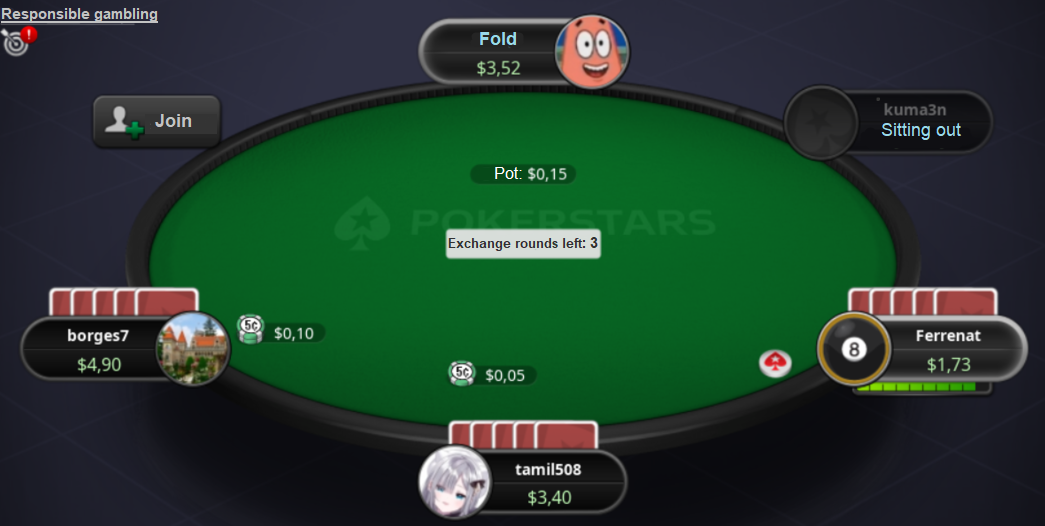
The initial steps closely resemble conventional poker. After setting the blinds, each engaged person receives 5 cards rather than the entire pocket set at once. Instead, they are distributed one by one and kept hidden (face down). Opponents cannot see each other's hands until the closing stage (showdown).

In the first betting stage, players assess their combinations and make appropriate decisions. Namely, call, raise, or fold.
This stage concludes either when wagers are equalised (meaning all players contribute identical amounts). Or, when someone successfully eliminates all opponents from the game. In the latter scenario, the victor seals the match and leaves with the pot.
When 2+ users remain, they move on to the drawing stage. There are three such rounds in 2-7 Triple Draw Poker, and you’ll find the same scheme in the Badugi game rules.

The opening exchange starts after all bets are arranged. Participants announce how many initial figures they wish to substitute. The first active punter left to the Big Blind starts the circle. One can choose to stand pat or remove all 5 cards from the initial combination.
Participating players clear unnecessary cards and get the exact number of new ones from the playing deck. Next comes the second betting auction. It unfolds under a similar scenario, but initiated by the one sitting left to the SB.

Everybody remaining at the 2-7 Triple Draw table can decide to throw out any unwanted cards if considered necessary. This phase shows who is still far away from forming a strong combination and who replaces 1-2 cards to level it up. Afterwards, users begin to "negotiate" for the third time.

You've loomed the final window, which enables a combination renewal before you enter the showdown. It’s necessary for players to carefully assess their winning chances and stick to standing pat or drawing one more card.
The concluding round of betting follows next. If multiple individuals stay in the game, the final phase starts (we refer to the showdown).

When the exchanging and betting parts are done, the surviving punters expose their collected combinations and compare them. The champion isn’t hard to crown: the one who manages to build the best low hand wins.
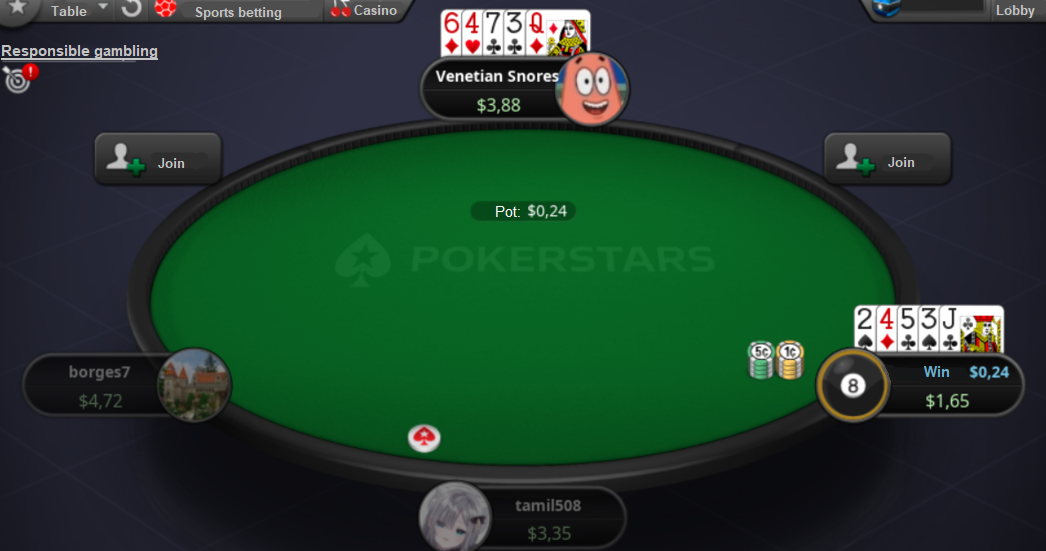
As the rules of 2-7 Triple Draw state, you should start the comparison with the highest-value cards. A few finalists may have identical tops, and in this case, you want to check the next elements by the rank order. Same again? Move to the third one and so on. In the screenshot below, 2-4-5-3-J takes the pot pool, not 6-4-7-3-Q, cause Jack is weaker than Queen.
Should finalists have equally strong holdings, the pot will be divided among them, making each a victor. This concludes the game, paving the way for a new matchup and a new pot to be played.

Otherwise dubbed as Deuce to Seven, it is a more dynamic variation of lowball draw poker. It implies 2 betting streets, not 4, and people go through one exchange phase, not three. Another noticeable distinction is that punters are allowed to go all-in for as much as they desire. This permission derives from a no-limit structure, which the game usually follows.
How to Bet & Exchange Cards in 2-7 Triple Draw
The active player who sits first to the big blind's left always opens the betting stage. Checking is traditionally directed clockwise. You can take advantage of these actions when competing for the pot in 2-7 Lowball Poker:
- bet – original amount wagered
- call – matching your rival’s bet/raise (who acts before you)
- raise – you bet more than the preceding wager by n times
- check – you don't pay and move the action to the next opponent
- fold – voluntary cessation of further participation in the action
Card Replacement Rules
The game features four betting rounds and three trading phases, during which users can get rid of the undesirable units. Explore the card exchange nuances below:
- Punters can change as many cards as they want. Moreover, they are even permitted to replace their entire holding if desired.
- If the current lineup fully meets their satisfaction, they declare a "stand pat" (there's a dedicated button in online games) and wait for the betting to kick off.
The deck runs short of cards? Then the dealer shuffles those discarded earlier. This lets punters draw substitutions, but generally, that's not a good spot because we usually fold bad (high) cards.
Should you decide to swap all five items, you will receive four new ones in return. The fifth element will be provided after other players complete their exchanges.
2-7 Triple Draw Poker Hand Rankings
If you have ever played Draw poker, you know that it follows the casual hand ranking (high to low). But everything you should follow here is the polar opposite. The reason is that low combinations are evaluated as victorious, not high. In other words, the weaker your cards, the more satisfactory.
2-7 Triple Draw has no shared cards that everyone involved in the action uses. The qualifying hand should originate solely from what you hold..
Explore the top 10 best possible combos (suits added as an example):
| 1. | 2♦ 3♠ 4♣ 5♥ 7♥ | 6. | 2♠ 3♣ 4♠ 6♦ 8♦ |
| 2. | 2♦ 3♦ 4♥ 6♣ 7♠ | 7. | 2♥ 3♣ 5♣ 6♠ 8♣ |
| 3. | 2♠ 3♣ 5♦ 6♥ 7♠ | 8. | 2♦ 4♥ 5♦ 6♥ 8♠ |
| 4. | 2♣ 4♦ 5♠ 6♠ 7♥ | 9. | 3♥ 4♦ 5♠ 6♣ 8♦ |
| 5. | 2♥ 3♣ 4♣ 5♠ 8♦ | 10. | 2♥ 3♣ 4♠ 7♥ 8♠ |
Terms of Hand Rankings
The key nuances to consider when forming your potentially winning combo in 2-7 triple draw lowball are below:
- Aces represent an exceptionally high rank, so A-2-3-4-5 shall not be considered as a straight;
- straights and flushes count, but they work against you – winning a pot with them is extremely challenging (so we advise avoiding them);
- three of a kind loses to pairs, straights to triplets, flushes to straights, full houses to flushes;
- A-K-Q-J-9 (mixed suits) stands as the weakest low-type hand;
- royal flush – as morbid as it sounds – is the worst possible combination.
As you can see, combinations in this game are graded oppositely to what is commonly seen in Holdem and Omaha poker. Hence, royal flush, quads and full house make no value here, just harm.
This discipline is much appreciated among poker enthusiasts worldwide, even by superior professionals like the legendary Daniel Negreanu, who enjoys playing it. With his strong command of the game, KidPoker wrote a section on fundamental principles of triple draw for the book "Super System 2" authored by his colleague, Doyle Brunson (who, regretfully, passed away in May 2023, at the age of 90).
2-7 Triple Draw Strategy Tips for Beginners
See strategy insights from Cardmates editors that might come in handy:
- Play from late positions. Since we lack the community board, betting and swapping as one of the latest is a big advantage. You already know how many elements your opponents have changed and understand who has the weak and strong combo. With this in mind, you can make an optimal decision.
- Raise when you’re strong. If you are dealt 7-high (or 8-high), you want to use it aggressively before the 1st exchange stage, since refusing to swap will make your combo obvious and your opponents may no longer pay you off. Therefore, there is no point in slow playing.
- Beware of straight draws. Four low elements are considered strong starters in 2-7 triple draw rules. Therefore, you should play them as aggressively as possible. However, these can quickly become the unwanted straights. Let’s assume you have 4-5-6-7. In this case, twos and nines are the only outs to improve your holding, but catching 3 and 8 is failure.
- Change behaviour in multi-pots. Your chances of getting 2 or 3 reduce drastically when 3+ punters are in the action. Low values (most likely) have already been taken from the deck and dealt to the rivals. Fold if 2 and 3 are your outs, and show aggression with a “pat” hand.
- 3-bet with a strong hole. It’s recommended to play more aggressively with the hole that is one item short of a complete low combo. It’s a smart move to identify the opponents’ combinations and make the weakest ones fold.
- Made hands are usually better. A low to Jack is always ahead of a four-card draw. A low to Queen is always ahead of a three-card draw. Opponents that need to draw 2+ cards have a weaker position as they need to avoid high cards, pairs, and straights.
Considerations for Advanced Players
As you master the basics and start confidently applying them at tables, it’s time to learn how to play 2-7 triple draw on a more professional level. Below are the advanced strategies to consider:
- Stand pat instead of drawing. This poker variation is a game of behaviour, so seasoned players may choose to stand pat with a weak hand to represent strength. Known as snowing, this approach requires the proper concept. E.g., if you see multiple players substituting 2-3 cards, it may be the right moment for bluffing.
- Distinguish the pat hands. Players with the strongest combos usually raise and stand pat from the very first round, but not all of them are genuine. The value pats are usually on the early positions, while late ones are more likely to bluff.
- Master check-raise tactic. Instead of bluffing, focus on check-raising for value. Do it with strong combos like 7-low or 8-low to create a powerful image for your competitors. They’ll later start to fold everything except for strong strings. Let bluff raises be 30%-40% of your gameplay.
Advantages and Disadvantages
- 2-7 Triple Draw Lowball is full of action, a dynamic and sometimes unpredictable format (in a positive way).
- Since the opposition can’t see your cards and there is no board, you can use bluffs. It often brings additional profit.
- Few players can boast of having great skills. So you can win money from inexperienced users if you hone your skillset and take them to an advanced level.
- Fixed-limit structure and the power to change cards three times reduce variance. This helps grasp principles of building combinations without much risk.
- You will have limited data for assumptions about the strength of your rivals’ hands, so you must always be extremely careful and watch your opponents.
- Novices may spend a lot of time learning strategy and tactics.
Where to Play 2-7 Triple Draw Online
This format falls significantly behind the popularity of traditional poker but occupies a unique niche in the industry. You can come across this game at major offline festivals, such as the WSOP, rather than find it on the web. Online, you can test-drive the gameplay at cash tables and tournaments on PokerStars, including both real money and play money modes.


#Ad 18+ Full T&C apply. GambleAware.org. First time depositors only. Min. deposit £10 with code 'STARS400'. Play on any real money table on the site within 120 days after making eligible deposit. Bonus released in £5 instalments every 100 redemption points. No withdrawal during bonus period. Please play responsibly.


#Ad 18+. Play Responsibly. UK first depositors only. Min. deposit: $10. Promo code: GET50. Bonus will be granted as tournament tickets gradually over 6 days and will expire after 24 hours. Full T&C apply. GamCare.org.

#Ad 18+ Full T&C apply. GambleAware. First time depositors only. Min deposit $10. Select 'Match Bonus' in cashier. Max bonus $600. Bonus released in $1 increment per $5 paid in net rake/tournament fees. 90 days after eligible first deposit to unlock full bonus. Withdrawal restrictions apply. Up to 50% Rakeback for new players until 30.04, as newcomers skip straight to Octopus status in Ocean Rewards.
Our Summary
Deuce-to-seven with three exchanges offers strategic and skill-based experience that may be enticing for players who can adapt. It moves away from the traditional betting streets and ranking of combinations. 2-7 Triple Draw is where initially a weak hand doesn’t mean it’ll lose in the showdown. This adds appeal to gameplay and will suit those bored with conventional action.
FAQ
📌 What is 2-7 Triple Draw?
In short, 2-7 Triple Draw is a lowball game for 2 to 6 poker players. It’s played with a standard 52-card deck. Everyone receives 5 hole cards facedown and uses them to create a qualifying combination. To leave with the pot, it must rank as low as possible.
🧐 What is the best hand in 2-7 Triple Draw?
Offsuit 2-3-4-5-7 with a gap in the numerical sequence is an absolute nuts. It is known as 7-high, the strongest set of cards for this poker variant. Players have three attempts to exchange cards and try to build it.
❌ Which hands count against me in 2-7 Triple Draw?
The worst are quads, flushes, straights, triplets, and pairs. The more high-ranking cards are in the string, the less valuable it is. Since Aces are always high, you should avoid them and discard them when possible.
❓ Do I use blinds or ante in 2-7 Triple Draw poker?
This game uses blinds as the system of mandatory pot contributions. Hence, there are always two players posting Small Blind (SB) and Big Blind (BB) before you get your pocket hole. Antes may occur in some variations and are optional there.
👑 How to win in 2-7 Triple Draw lowball?
Players have to build a combo with the bottom value. They can be dealt the “Pat Seven” initially or increase the strength by replacing weak cards during the 3 exchange stages.
🎯 What are common starting hands in 2‐7 draw?
Common starters to enter the action with are those containing a deuce and 2+ low values. Something close to 7‐5‐4‐3‐2, but unsuited and without the risk of becoming a straight. Pat hands like 8‐5‐4‐3‐2 and 7‐6‐4‐3‐2 should also be considered.







Please, login or register.