
Chinese Poker Rules Explained
An unusual game of Chinese poker occupies a special niche among other poker variations. It uses conventional combinations and hand ranking. This guide will be a good starting point if you’re looking to discover the main Chinese poker rules, its unit system, hand order, scoops, and other features. The expert tips and strategies provided will polish your knowledge and protect you from fouls.
Introduction to Chinese Poker
This game variant has its roots in Asia. The table hosts 2 to 4 people. The standard 52-card deck is only necessary (you don’t need chips and buttons). Before the main round starts, each participant gets a set of 13 private cards. The goal is to arrange them into three rows, starting from the strongest hand and finishing with the weakest. All combinations are private as no items are on the board.
Chinese poker is merely a hand setting game with no betting or drawing rounds.
The formed hands match those of the conventional poker games. That’s the only aspect it shares with Hold’em and Omaha. Players don’t have to place obligatory blinds, as well as raise, call, or bluff to win the pot. Instead of cash values for bets, the special points are used. These determine the winning amount after the showdown.
Chinese Poker Rules Examined
Here are the essential principles and terms of the game:
- Stakes. All table agrees on the unit value. It usually starts at £1 and can reach any higher amount. Any bottom, middle, or top combination that beats the opponent’s one is equal to 1 point. After defining the point value, grinders can enter the action.
- Hand setting. Each of the 13 hole cards participates in building the final lineups. Form these as the established hierarchy dictates: the strongest goes to the bottom, and the top one acts as the weakest.
- Hole cards. The dealer gives every person 13 face-down items at once. If there are fewer than 4 participants at the table, the remaining items on the deck are put aside and not used in this round. You won’t see any cards on the deck – players build combinations using their own cards.
- Rankings. Chinese poker hands match with the conventional high-card ranking system, where 2 is the lowest value, and Aces are the highest. Therefore, the worst combo to arrange is the high card. The sequence from A to 10, known as Royal Flush, has the highest rank.
- Taking the pot. After arranging the lines, the entire table reveals 3 combinations each. Every punter compares each string to the corresponding one of every other opponent at the table.
Extra Rules in Chinese Poker
Apart from the core mechanics, there are a few important Chinese poker game rules to study:
- Surrender. Some pastime variations come with a surrender option. With it, you can fold your 13 cards if you believe you have a losing combo. Just mind that this decision will cost you a 2-unit penalty paid to everyone from the opposition. If there are three of them, you’ll lose 6.
- Foul (dead hand). It’s also known as mis-set, a situation where punters fail to meet the correct order of combos. Foul happens if the weakest combo appears on the front row, or the strongest appears in the middle, etc. In this case, the participant is disqualified and pays a fixed penalty to others: 6 units.
- Scoop. If your bottom, centre, and top line wins the opposition, it is dubbed “scooping.” It activates the bonus of 3 points credited to the player. As a result, the grinders who scoop earn 6, provided that the traditional 1-6 scoring system applies.
How to Play Chinese Poker?
The gameplay of this variation is easy to grasp, thus perfect for rookies. Study a step-by-step guide on how the round is organised below:
Decide the unit amount
Two to four individuals can play this format at the same time, but most often the game is played between three opponents. All participants agree on the comfortable value for Chinese poker points and continue.
Build the hand
Each player receives thirteen cards face down. The round starts. Everyone has to lay them in three rows (boxes) according to the combination position in the ranking system. The high-rank combo is at the back, while the weakest is at the top. Usually, the round lasts 2-5 minutes.
Here is the necessary order for laying out the Chinese poker hands:
- Bottom (5 pieces) – the most powerful lineup;
- Middle (5 pieces) – medium-value hand;
- Top (3 pieces) – the weakest arrangement.
Chinese poker strategy centres around making combos in a specific order - from strongest to weakest. If you break this rule, then your hand will be considered dead or foul. It automatically means losing to all other players at the table. For example, a foul is two pairs in the back and a set (trips) in the middle line.
Calculate the points
Then comes a moment when everyone’s fate is decided. At the showdown, each punter turns the cards face up to show the built lineups. To calculate the earned units correctly, participants should assess the strength of the top, mid, and bottom lineups separately.
No fixed order for assessing hands is applied. If there are 3+ individuals on their seats, the showdown may run like this:
- A vs B
- A vs C
- A vs D, and so on.
If the Chinese poker match ends in a tie, all players finish with zero points on the balance.
On average, each hand you win adds 1 unit to your overall score. If you scoop, you get 3+ units additionally to 1 per line. So, you score 6 in total. However, the exact number of units may vary, as there are two scoring systems and royalty bonuses we’ll discuss below.
Quick Sample Gameplay
Here is a practical example to better understand how to play Chinese poker. The string you see in the picture below is the dead one.
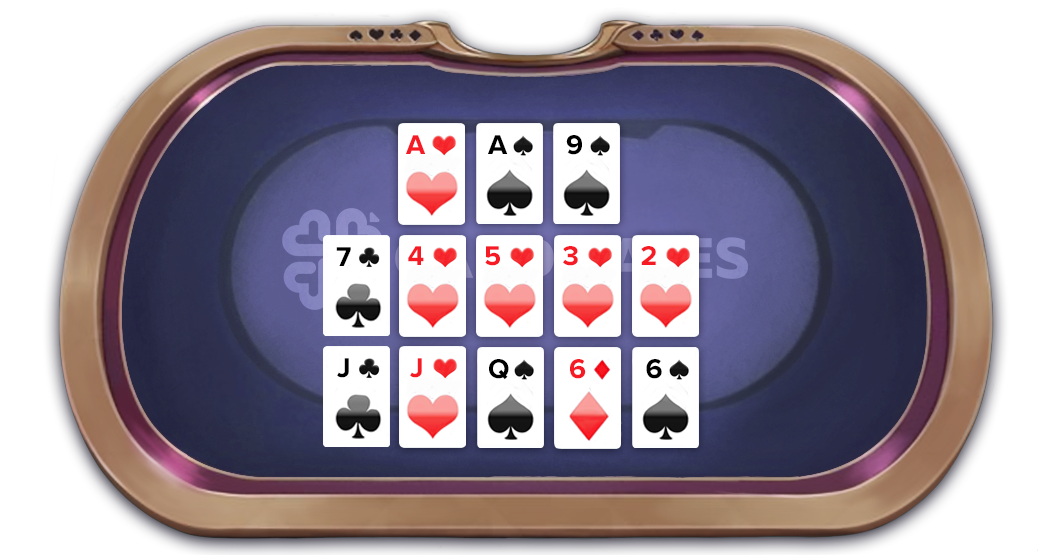
The punter in the picture above violated the order of combinations:
- Bottom – 6-6 and J-J;
- Middle – 7-high;
- Top – A-A.
A pair of aces sits higher than 7-high, which means a foul. This individual has lost to all his opponents.
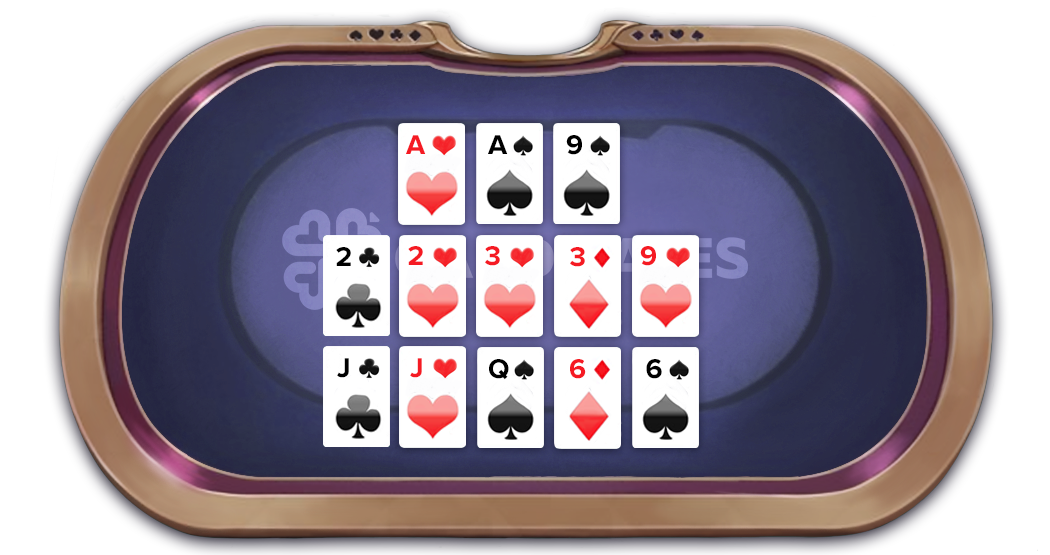
The example with the correct arrangement of items is below. In this case, the lineup isn't considered a dead one: the weakest in the first sector (AA), two pairs in the second line (22 and 33), two pairs in the third row (jacks and 66).
Key Aspects of Hand Ranking
Card combinations are where this variation intertwines with the traditional pastime. If you have a background in Hold’em or Omaha, switching to this game may be as easy as pie. Discover all Chinese poker hand rankings alongside the useful position insights.
| Combo | Example | Placement limit |
|---|---|---|
| High card | A♥-J♦-4♣ | Good for the back |
| Pair | 10♠-10♥-4♦ | All but the top row |
| Two pair | J♠-J♥-6♦-6♣-4♠ | Bottom and center work best |
| Three of a kind | 4♠-4♥-4♦-Q♣-J♥ | Fits all three positions |
| Straight | 6♠-5♥-4♦-3♣-2♠ | Fills rear sectors |
| Flush | K♠-J♠-8♠-5♠-2♠ | Perfect for middle and back lines |
| Full House | 9♠-9♥-9♦-3♣-3♥ | Best for mid & back rows |
| Quads | 7♠-7♥-7♦-7♣-J♥ | Strong for the back and center |
| Straight flush | 9♠-8♠-7♠-6♠-5♠ | Works only in the mid and the bottom |
| Royal flush | A♠-K♠-Q♠-J♠-10♠ | All except the top |
High card, pairs, and triplets are the only Chinese poker combinations that can appear on the front row.
How to Arrange a Qualifying Set of Hands?
This algorithm will help you arrange 13 random cards into qualifying hands faster:
- Scan your hole items. Take a look at your lineup and group them by rank or suit.
- Look for sequences first. Place flushes or straights on the two back sectors if they are.
- Spot pairs. It is very frequent to have a four- and five-pair lineup and allocate it in descending order.
- Form the front position. Arrange the remaining cards in the top sector.
- Double-check the ranking. See if all the lines you filled follow the hierarchy.
Chinese Poker Scoring Systems: 1-6 vs 2-4
The game determines the round champion based on the total points scored and the scheme applied. 1-6 and 2-4 are the most popular ones. Let’s discover them in more detail.
1-6 is the scheme you’ll face most frequently when playing cash tables and tournaments. The basic rules it follows are below:
| Lines won | Prize points |
|---|---|
| 1 | 1 |
| 2 | 1 |
| 3 | 6 |
The 2-4 scoring system is less popular but still used sometimes. Check how it differs from the scheme above:
| Lines won | Prize points |
|---|---|
| 1 | 1 |
| 2 | 2 |
| 3 | 4 |
Points are calculated after all players have laid out their combos.
![Tom Schneider, World Series of Poker bracelet winner]() Tom Schneider, World Series of Poker bracelet winner
Tom Schneider, World Series of Poker bracelet winner"The great thing about Chinese poker is that it seems like an easy game, and until you play it, you never know how many mistakes you can really make."

Royalties and How They Work
Chinese poker rules state that punters can earn extra rewards by landing strong cards on the correct positions. These rewards are known as royalties. Participants declare it when building hands, but get the points only in the showdown.
The number of bonus units they award, as well as the participating combo, varies in different poker variations.
Look at the combinations and rows required for them to earn the royalty bonus below:
| Combo | Line | Royalty |
|---|---|---|
| Three of a kind | Top | 3 |
| Four of a kind | Center | 3 |
| Bottom | 2 | |
| Full House | Center | 1 |
| Straight Flush | Middle | 4 |
| Back | 3 |
Note that royalty bonuses are optional and may be absent, so check the rules before joining the table.
Naturals
There’s a separate set of royalty bonuses which don’t require forming all hands. Naturals are formed of 13 hole cards that you are dealt. If they appear, you can get an increased number of points at once.
Learn how to play Chinese poker with naturals – a common structure is below:
- Clean Dragon (108 pts). 13 cards of one suit in numerical order from deuces to Aces.
- Dragon (306 pts). Cards in order from 2 to A of different suits.
- All Broadways (32 pts). These are A-A-A and 10 picture items.
- 3 Straight Flushes (24 pts). Two five-card straight flushes and a 3-card straight flush.
- Three Quads (20 pts). It consists of three four-of-a-kinds and 1 extra piece.
- All Low2/ Highs1 (12 pts). All Low2 only includes cards with a value of 8 or lower. Highs1 combination only has items of 8 or higher.
- Full-coloured (10 pts). This string can only be entirely red or entirely black.
- Four Triples (8 pts.). It is formed of 4 sets and 1 unused piece.
- Six-and-a-Half Pairs (6 pts.). These are 6 pairs with 1 extra card, where quads always count as 2 pairs.
- Three Straights (4 pts). This bonus combo has two 5-card straights and 1 made of three elements.
- Three Flushes (3 pts.). Two 5-card flushes with one 3-card flush form this hand.
- No Broadway (3 pts.). There are no picture items from 2 to 10, without Aces.

In Finland, there is an unspoken rule of the deuce of spades bonus between players. If they appear, they double the royalties, no matter if the lineup is a winning one or not. For example, for a flush, you get twice as many points: not 4, but 8.
Chinese Poker Strategy That’ll Lead You to Scooping
The game has its specificities that should be kept in mind when building your playing tactics. Learn how to distribute strength across three positions properly and score units round by round.
Pay Attention to Kickers to Avoid Fouls
We often see how beginners ignore kickers when assessing the strength of the formed lines. Suppose your starting lineup is: Q♠-J♥-Q♦-Q♥-10♣-Q♣-4♣-9♠-4♥-2♠-4♠-4♦-8♦. The optimal decision in this case would be to play Two Pair in the back and middle. Most of the beginners do it, but make a common mistake. Take a look at it:
- Bottom: Q♠-Q♦-4♣-4♥-8♦
- Center: Q♥-Q♣-4♠-4♦-9♠
Punters assume the combos are equal, completely ignoring the kicker's role in strength evaluation. So, you should always check that the back one is higher. It is the most effective strategy for Chinese poker.
Split Full House Wisely
Noticing Full House in your hole cards may feel like a jackpot until you understand that the back takes the core strength and leaves the remaining rows lacking value. We’ll remind you that the goal is to win with as many lines as possible, not with a big hand. See when splitting the boat becomes the optimal solution:
Hole cards: 4♠-4♦-4♥-J♣-J♦-10♠-9♥-8♣-7♦-6♣-A♠-K♥-2♣
Many beginners will place 444JJ at the bottom. But sometimes it is necessary to allocate the value in another way.
- Back: 10♠-9♥-8♣-7♦-6♣
- Middle: 4♠-4♦-4♥-A♠-2♣
- Front: J♣-J♦-K♥
This setup respects the proper order of combinations, and it is still one step away from the competitors. Straight at the bottom is the strongest. In almost half of the cases, trips in the centre are to give you winning points, while the front pair is likely to be the champion as well.
💡Stick to base hand-building goals. Understanding the lowest target combos for each line to get around faster:
- Top: High Card
- Mid-row: Pair
- Back: Two Pair
Types of Chinese Poker
The traditional face-down game has evolved and given rise to plenty of variations that retain the original purpose but step back from the original rules. Get familiar with the most popular upgrades of classic Chinese poker:
- Open Face Chinese poker (OFP). The initial lineup for each participant is 5 cards. The object is to start filling positions on the board, but laying them face up. As the card is placed, its position remains fixed. As the starting cards end, players can continue forming hands, getting 1 more piece in each next round. It makes forming the combination more difficult.
- OFP with Fantasyland. This version stands out with its bonus round, giving punters an advantage. While participants in the base game get the remaining cards piece by piece, entering the bonus round allows to receive the 13-card set right away. Forming a pair of queens or higher in the top row is the entering condition. Showdown starts only when all participants complete their combos. To make an extra round last longer, form a set, full house or quads.
- Pineapple. The distinction between Pineapple open face Chinese poker and its traditional predecessor lies in how the cards are dealt. Pineapple players get 5 items at once, and then receive a set of 3 cards in each of the following phases. Only 2 cards can participate in the match, while 1 item is to be discarded.
Where to Play Chinese Poker
This pastime is a niche one, so British punters won’t find it in the lobbies of the UK-licensed poker rooms. You can test-drive the gameplay in free mobile apps. Local casinos may offer it, but it’s not that popular to find such tables behind every other door.
Top Online Rooms for Beginners


#Ad 18+ Full T&C apply. GambleAware. New UK players only; min £10 deposit; 100% up to £1,000 deposit bonus paid in cash. £50 Free Play in P$, Partypoker Tour Path & SPINS Overdrive tickets released over 6 days. 14-day ticket expiry.


#Ad 18+ Full T&C apply. GambleAware. UK first depositors only. Min. deposit: $10. Promo code: GET50. Bonus will be granted as tournament tickets gradually over 6 days and will expire after 24 hours. Full T&C apply


#Ad 18+ Full T&C apply. GambleAware. First time depositors only. Min deposit $10. Select 'Match Bonus' in cashier. Max bonus $600. Bonus released in $1 increment per $5 paid in net rake/tournament fees. 90 days after eligible first deposit to unlock full bonus. Withdrawal restrictions apply. Up to 50% Rakeback for new players until 30.04, as newcomers skip straight to Octopus status in Ocean Rewards.
Conclusion
While classic Holdem and Omaha poker games are a psychological battle, the Asian take on traditional pastime is a game of puzzle-solving. The prior background in conventional variations might be useful. But the rules for Chinese Poker need to be clearly understood. Use our guide and strategies to quickly get around lines, fouls, and royalties.
FAQ
💡 What is Chinese poker?
It’s a card game that follows a conventional hand ranking system and combinations, but hands work differently. Each grinder gets 13 cards as the starting lineup. The aim is to build three combos in descending strength. Betting rounds don’t exist, and the winner is defined by the total of acquired points.
💎 Can you play Chinese poker with more than four people?
No, the maximum number of participants is 4 players. There are exactly 4 sets of 13-card hands in the standard 52 deck. If there are 5-6 grinders at the table, they won’t have items to play as this variation uses only 1 deck.
⭐ How does a fouled hand affect the scoring?
If the combinations on your lines don't align with the required order, you pay a penalty. The example of a fouled combo is a pair, laid out on the bottom when it should actually be the front one. If you make foul, you pay 6 units to each opponent and lose all royalties.
🔥 Which hands automatically scoop in Chinese poker?
No specific lineup could lead the punter to an automatic scooping. However, it’s possible to win with naturals. It doesn’t require a player to arrange the three-line setup. Naturals are prize hands formed in a 13-card set dealt before the action starts.
🎲 What are the rules for surrendering in Chinese poker?
Participants can choose to give up if the initial lineup isn’t strong enough. It’s an alternative to folding in Texas Hold’em, but it comes with a penalty of 3 points – you should pay it to each opponent. Surrender is optional; some versions don't offer it.
🎯How does the Chinese variant of poker differ from Holdem?
These two pastimes differ drastically in rules and gameplay. The Chinese format allows up to 4 punters at the table, while Hold’em typically seats 2-10 players. Individuals won’t see traditional blinds, board cards and betting stages here. In Hold’em, your goal is to form the strongest combo, while in the Chinese version, participants use 13 private cards to build 3.








Please, login or register.